


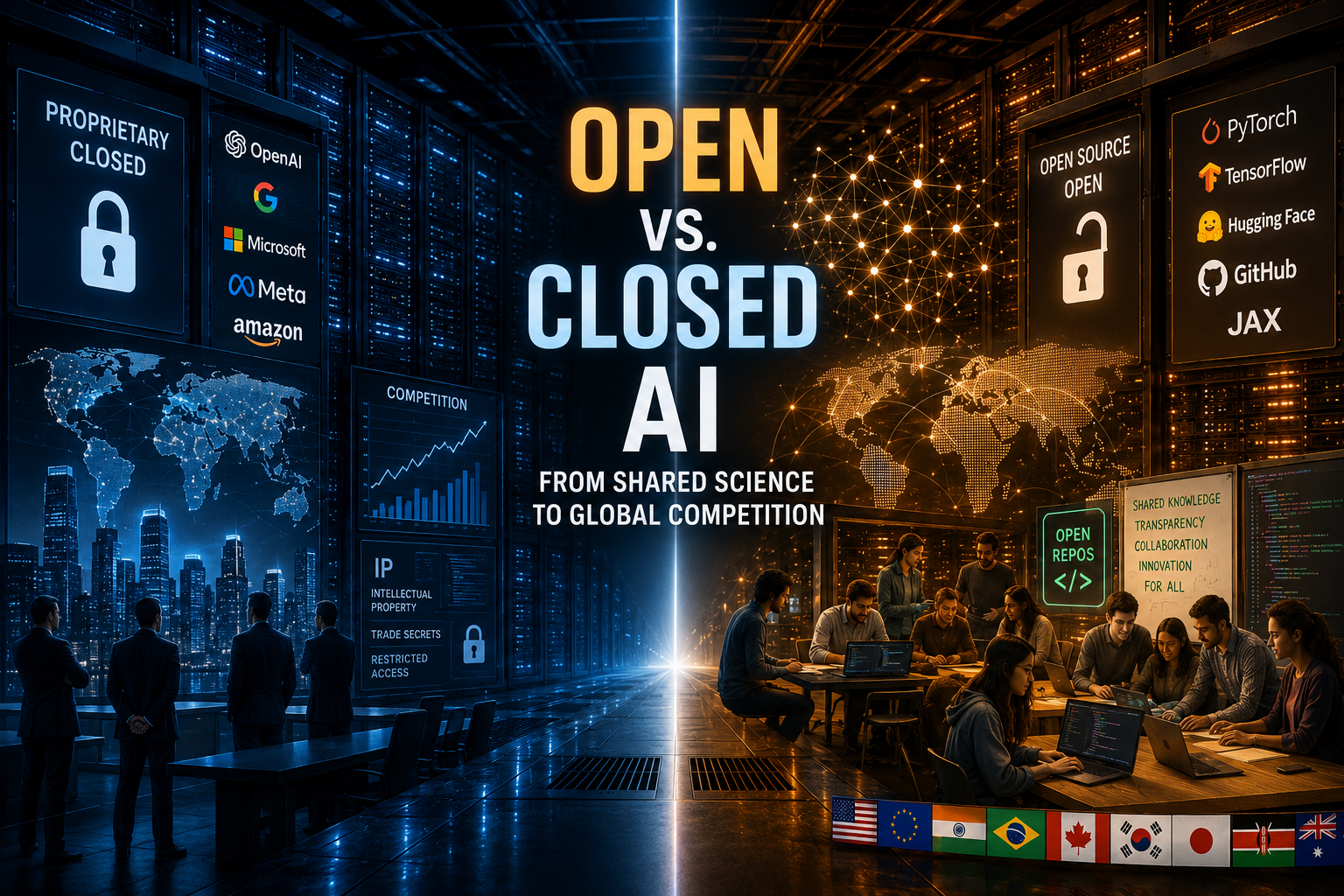
What began as a culture of shared research has become one of the most consequential commercial rivalries in technology history — and the ground keeps shifting underfoot.
A field that used to share everything
For most of AI’s history, openness was the norm. Even through the cycles of hype and disappointment that researchers came to call “AI winters,” the culture of the field was collaborative. Papers were published, architectures were shared, and progress was collective. The arrival of deep learning changed that dynamic slowly at first, then all at once.
As neural networks began delivering genuine commercial value, the incentives shifted. Competitive advantage, investment returns, and market leadership entered a field that had previously been driven mostly by scientific curiosity. The idea that a model’s architecture — or even its existence — was something to protect began to take hold.

The closed model playbook emerges
A telling early signal came with GPT-1 in 2018. OpenAI published the research describing how the model worked, but did not release the weights themselves. It was a subtle distinction that would come to define an era: describe the method, keep the artifact. The model also demonstrated something important — that large-scale pretraining followed by fine-tuning could adapt a single general system to many different tasks.
By 2022, with the release of ChatGPT and GPT-3.5, the gap between proprietary and open systems was unmistakable. These models reached a mass audience, established a strong performance lead, and made clear that closed providers had structural advantages: vast undisclosed datasets, enormous compute budgets, and the ability to iterate privately without revealing what they had learned.
The data problem. One of the least-discussed advantages of closed labs is data. Proprietary models are often trained on datasets that are never disclosed publicly. Since data quality shapes capability more than almost any other factor, this asymmetry quietly compounds over time.
Open source fights back
The open community never stopped building. Projects like GPT-J and GPT-NeoX from EleutherAI, BLOOM from Hugging Face and BigScience, and early Mistral models showed that community-driven development could produce genuinely capable systems. But the cost trajectory was punishing — as models grew, the resources needed to train them moved increasingly out of reach for independent contributors.
The situation changed in 2023 when Meta’s LLaMA weights leaked publicly. The consequences were immediate and widespread. Developers suddenly had access to a high-quality foundation model that could run on accessible hardware, and the ecosystem exploded. Alpaca, Vicuna, Falcon, RedPajama, and dozens of Mistral-based variants emerged in rapid succession. For the first time, open models were beginning to close the gap with proprietary systems in a meaningful way.
Reasoning opens a new frontier — briefly
Just as open models were finding their footing, the frontier moved again. In 2024, OpenAI introduced reasoning-focused systems that used reinforcement learning to solve complex, multi-step problems at a level that benchmarks had not previously seen. The gap widened once more, and proprietary labs appeared to have reasserted their lead in the capabilities that matter most for demanding applications.
It did not last long.
The moment that changed the economics
In early 2025, a Chinese AI lab released an open reasoning model — DeepSeek-R1 — that matched the performance of the leading proprietary reasoning systems on most benchmarks, at a training cost that was a small fraction of what Western labs had been spending. The reaction across the industry was swift. Markets moved. Infrastructure assumptions were questioned. The idea that frontier-level AI required frontier-level budgets suddenly looked uncertain.
The release forced a genuine reckoning with the economics of AI development. If a capable reasoning model could be built and released openly for a fraction of what closed labs were spending, what exactly were users paying for when they subscribed to proprietary APIs? The answer turned out to be complicated — and the question is still being argued.
Where things stand in 2026
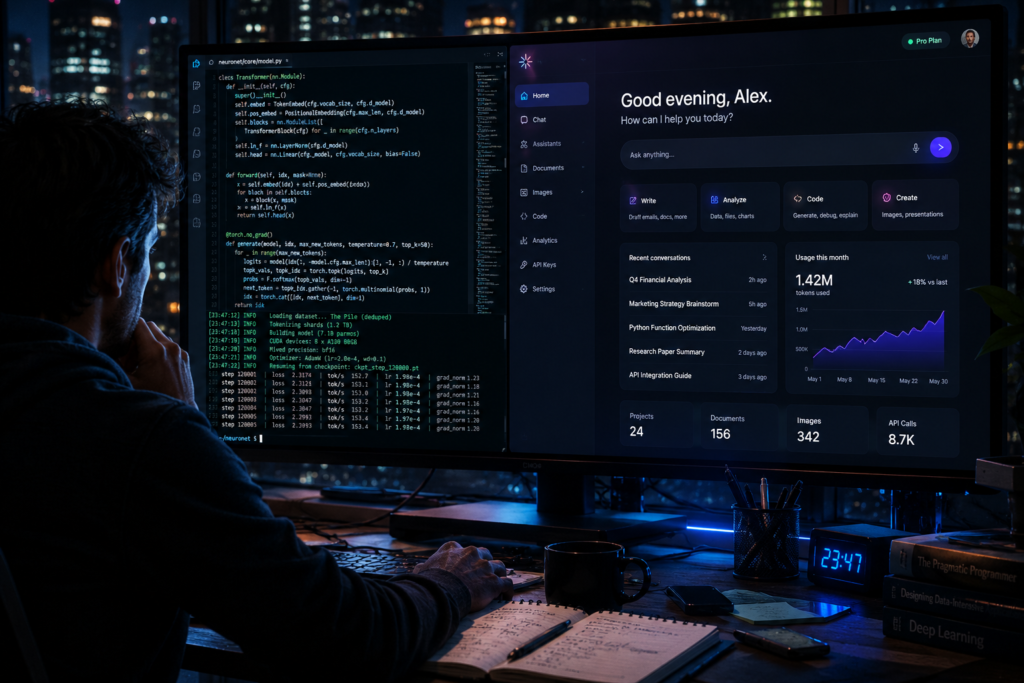
By mid-2026, the benchmark picture has changed substantially. On knowledge, mathematics, and graduate-level science tasks, the best open-weight models are competitive with or match leading closed systems. The gap that once separated the two camps has effectively closed for the majority of common production use cases — coding assistance, content generation, classification, summarization.
Open models now offer
Near-parity on most benchmarks, extremely long context windows, native multimodal input, and the ability to run privately on your own infrastructure — a major advantage for regulated industries where data cannot leave the organization.
Closed models still lead on
The absolute frontier of reasoning and complex agentic tasks, more polished multimodal integration, and the full weight of proprietary R&D investment — including safety work and alignment research that open projects have not yet replicated at scale.
The leading open-weight contenders now include Meta’s Llama 4 family, DeepSeek’s latest reasoning-focused releases, Alibaba’s Qwen 3 series (particularly strong on math and science), and newer entrants like Kimi K2 from Moonshot AI. On the closed side, the frontier is held by OpenAI’s GPT-5 family, Google’s Gemini 3, Anthropic’s Claude Opus 4 series, and xAI’s Grok 4.
The real trade-off is no longer performance
For most organizations making decisions today, raw benchmark scores are almost beside the point. The more pressing question is strategic: what are the real costs and risks on each side?
Open models eliminate dependence on a vendor’s pricing, terms of service, and continued existence. They allow deployment inside a private network, which matters enormously for healthcare, finance, and government. The EU’s AI Act and similar regulations have made data localization a hard requirement in many contexts, effectively mandating open or self-hosted deployment for a growing range of applications.
But self-hosting carries its own costs. Infrastructure, expertise, ongoing maintenance, and the need to stay current with a fast-moving field all add up. The “free” in open-source refers to the license, not the total cost of ownership. Some organizations have discovered this the hard way; others have found that a hybrid approach — open models for sensitive or high-volume workloads, closed APIs for cutting-edge tasks — gives them the best of both.
The collapse of the moat. The gap between open and closed AI did not narrow gradually — it dropped sharply in a series of discrete moments. Each time the closed-model community thought the distance was safe, a new open release arrived and reset expectations. Whether that pattern continues is the central question facing the industry.

What comes next
Two futures remain plausible. In one, open models continue improving fast enough that paying for proprietary access becomes difficult to justify for most users and most tasks. In the other, closed labs maintain their lead at the true frontier — not through secrecy alone, but through continued investment in the kinds of research, safety work, and infrastructure that are genuinely hard to replicate outside a well-funded lab.
The most likely outcome is neither. Both sides will continue to advance. Open models will democratize access to capabilities that were recently proprietary. Closed labs will push further ahead on whatever turns out to be hardest. And the boundary between them will keep blurring — as it already has, in ways almost no one predicted even two years ago.
What is no longer in doubt is that open-source AI is a serious alternative for a wide range of real-world applications. The question is no longer whether to consider it — it is how to decide, case by case, which approach serves each need best.