


Published: June 7, 2026 | Last Updated: June 7, 2026
AI agents are arguably the most consequential shift in how organizations get work done since the spreadsheet. But after three years of watching companies deploy them — some brilliantly, most poorly — I’ve come to a conclusion that most vendor marketing glosses over: the technology isn’t the hard part. The organizational readiness to use it is.
This article covers what AI agents actually are, what the data says about their impact, where they’re genuinely working (with real examples), and where the hype is still running far ahead of reality.
What Are AI Agents?
An AI agent is a software system that uses artificial intelligence to pursue specific objectives by interacting with data, tools, software applications, or users — with meaningful autonomy over how it reaches those goals.
Most AI agents combine several capabilities: natural language understanding, reasoning and decision-making, task planning, tool usage and system integration, and memory across a session or workflow.
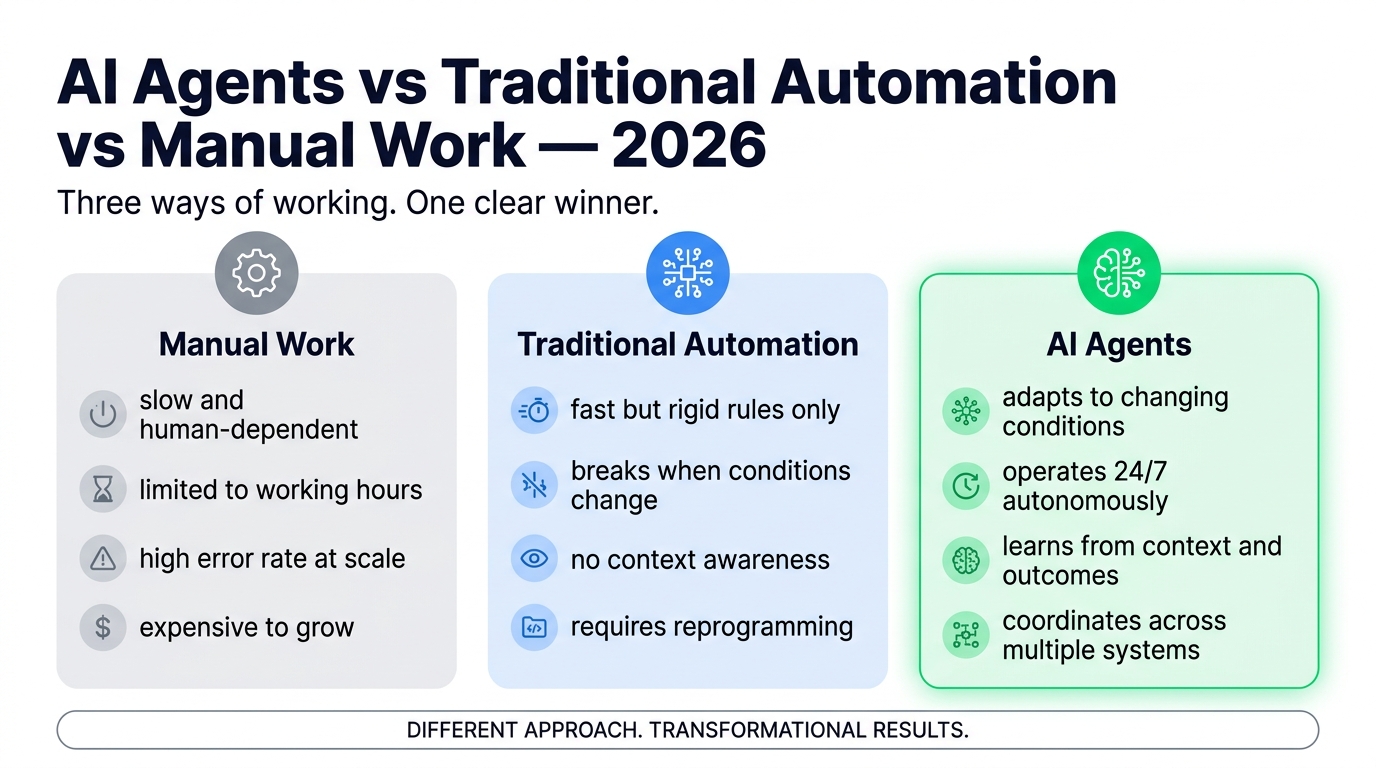
The distinction from a standard AI chatbot is critical. A chatbot answers a question. An agent completes a workflow. For example, a customer service AI agent doesn’t just draft a response — it reads the incoming request, identifies the issue, searches documentation, generates a reply, creates a ticket in the CRM, and escalates edge cases to a human. It acts across systems rather than just generating text.
How We Got Here: From Rigid Automation to Goal-Oriented Systems
Traditional automation — robotic process automation (RPA), rule-based workflows — executes predefined instructions. It works well when every scenario is anticipated in advance. But the real world isn’t that tidy.
AI agents introduce a more flexible approach. Instead of requiring an explicit rule for every scenario, they interpret context, adapt to changing conditions, and determine appropriate actions within established constraints.
This represents a movement through three stages:
- Task automation — automating individual, repetitive actions
- Workflow automation — automating sequences of connected actions
- Goal-oriented automation — enabling systems to pursue outcomes with minimal supervision
According to Gartner’s 2024 Strategic Technology Trends report, agentic AI ranks among the top 10 strategic technology trends for 2025. The firm projects that by 2028, 33% of enterprise software applications will include agentic AI — up from less than 1% in 2024. That’s a 33-fold increase in four years.
The Data: What’s Actually Happening
Before diving into industry applications, it’s worth grounding the discussion in what rigorous research actually shows — because the hype and the evidence don’t always align.
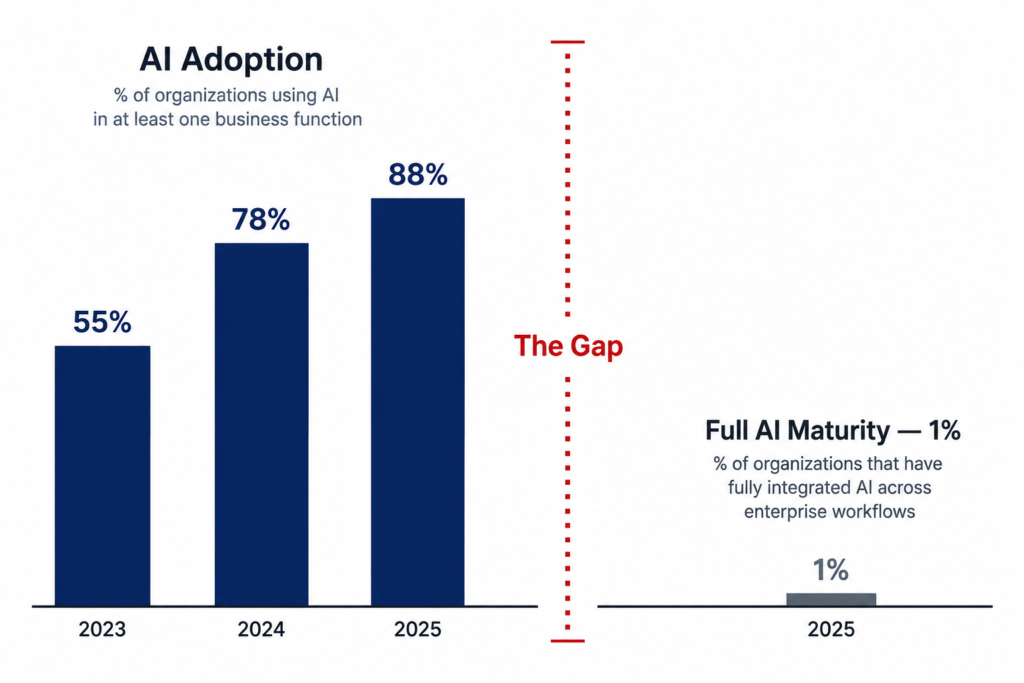
The adoption curve is steep. As of 2025, 88% of global organizations reported using AI in at least one business function, according to McKinsey’s State of AI Global Survey — a 10 percentage point jump from the prior year. A separate Worklytics 2025 AI Adoption Benchmarks report found that 75% of global knowledge workers now use AI tools regularly, with adoption nearly doubling in the second half of 2024 alone.
The productivity gains are real but uneven. Employees using AI report an average 40% productivity boost in self-reported surveys, and controlled studies show 25–55% improvements depending on the function. According to data published by Gartner in 2025, early adopters of agentic AI systems specifically reported 22.6% productivity improvements and 15.2% average cost savings.
But most pilots never scale. This is the part the press releases don’t mention: according to BCG’s AI Adoption research, 74% of generative AI pilots fail to move to scaled production, often stalling in what BCG calls “pilot purgatory” — due to data quality problems, governance gaps, or workforce resistance. McKinsey’s same 2025 survey found that only 1% of business leaders say their companies have reached AI maturity, defined as AI being fully integrated across enterprise workflows.
My take: The gap between “we’re using AI” and “AI is transforming our operations” is enormous. Most companies are somewhere in the messy middle — experimenting enthusiastically but structurally unprepared to scale.
Why AI Agents Matter: Five Real Business Benefits
1. Productivity for Knowledge Workers
Knowledge workers spend a disproportionate amount of time on administrative and repetitive activities: document preparation, information retrieval, data entry, email management, report generation.
Federal Reserve research on generative AI productivity quantified AI’s time savings at an average of 5.4% of work hours — roughly 2.2 hours per week for a full-time employee, or essentially one full workday reclaimed per month. Frequent users gain significantly more: 27% of AI users save over 9 hours per week.
Separately, McKinsey’s June 2023 analysis of generative AI’s economic potential sizes the long-term opportunity at $4.4 trillion in added productivity growth potential from AI corporate use cases.
2. Continuous Operations Without Staffing Costs
Unlike human teams, AI agents operate 24/7 without shift changes, sick days, or burnout. For global customer support, IT monitoring, security operations, and e-commerce, this removes a structural constraint that has long forced a trade-off between service availability and cost.
Real example — Klarna: In early 2024, Klarna’s customer service AI assistant handled roughly two-thirds of incoming support chats in its first month, managing 2.3 million conversations. It cut average resolution time from approximately 11 minutes to under 2 minutes — equivalent to roughly 700 full-time employees of capacity. The company cited an estimated $40 million profit improvement in 2024 tied to AI efficiencies, with a follow-up Q1 2025 update confirming a roughly 40% reduction in cost per transaction since early 2023.
Real example — Vodafone: The telecommunications company deployed an AI agent-based support system that handles over 70% of customer inquiries without human intervention, reducing average resolution time by 47% — a deployment documented by Microsoft in their 2024 AI use case research.
3. Decision Support at Scale
AI agents can synthesize large volumes of structured and unstructured data quickly — making them valuable for market analysis, financial research, risk assessment, and legal review.
Real example — JPMorgan Chase: The firm’s Coach AI tool enables advisors to respond 95% faster during market volatility events, dramatically improving client communication speed without increasing headcount.
Critically, AI agents in high-stakes domains should be treated as decision-support systems, not decision-makers. The distinction matters both ethically and legally.
4. Scalability Without Proportional Headcount Growth
AI agents let organizations serve more customers, process more transactions, and expand services without a proportional increase in operational costs.
Real example — Synthesia: During a 690% volume spike in support demand, Synthesia’s AI agent — powered by Intercom’s Fin, built on Anthropic Claude — resolved 6,000+ conversations with 98.3% of users self-serving without human escalation, saving over 1,300 support hours in six months.
5. End-to-End Workflow Coordination
Perhaps the most underappreciated capability of AI agents is their ability to coordinate across multiple systems — researching information, updating databases, creating documents, communicating with stakeholders, and triggering downstream processes — without human handoffs at each step.
Industries Being Transformed: What the Real Numbers Show
Healthcare
Research published in 2025 on healthcare AI ROI found that organizations using AI agents are seeing a $3.20 return for every $1 invested within 14 months. The global healthcare market for agentic AI was estimated at $538.51 million in 2024 and is projected to reach $4.6 billion by 2030.
Key applications include clinical documentation (freeing physicians from hours of note-taking), automated prior authorizations, appointment scheduling, and patient communication. The constraint remains clear: clinical decisions require qualified medical oversight, and the regulatory environment rightly enforces that.
Financial Services
McKinsey’s financial services AI research projects 15–20% net cost reduction across the banking industry from AI adoption. AI-powered loan processing is already delivering a 90% increase in accuracy and 70% reduction in processing times in leading deployments, with approval times cut from days to under 60 seconds.
Regulatory requirements mean human review of AI outputs remains essential in most financial jurisdictions — and that’s a good thing, not an obstacle.
Manufacturing
According to manufacturing industry research published in 2025, 61% of manufacturing executives report decreased costs as a direct result of AI in supply chain management. Predictive maintenance agents — which monitor equipment data in real time to forecast failures and schedule interventions before downtime occurs — are among the highest-ROI applications in this sector.
Retail and E-Commerce
NVIDIA’s 2026 industry survey found that 95% of respondents in the retail and consumer packaged goods sectors reported that AI decreased their annual costs. Demand forecasting, inventory management, and personalization are the leading use cases.
Software Development
AI coding assistants have shown measurable gains, but with an important caveat: a 2025 METR study on developer productivity found that experienced developers actually took 19% more time to complete complex coding tasks when using AI tools — despite believing they were 20% faster. For routine code generation and documentation, gains are real. For complex, novel problem-solving, the productivity narrative is more complicated.

How AI Agents Are Changing Jobs
The widespread concern that AI agents will simply eliminate jobs deserves a more nuanced answer than most headlines provide.
Forrester’s research on AI’s US workforce impact through 2030 projects 6.1% of US jobs will be lost to AI automation, with 20% significantly impacted — but the firm is explicit that “AI will take over increasing numbers of workflows and tasks, but workflows and tasks aren’t jobs.” The historical pattern with automation holds: roles transform more often than they disappear entirely.
What is changing is the composition of work. Professionals are spending more time on strategic decision-making, creative problem-solving, relationship management, and AI supervision — and less time on repetitive information processing. New roles are emerging: AI Operations Specialists, Prompt Engineers, AI Governance Officers, AI Auditors, and AI Workflow Designers.
Gartner also projects that by 2029, half of all knowledge workers will be building and managing their own AI agents as a core part of their job — a finding detailed in their agentic AI workforce maturity research.
Challenges and Risks: The Parts That Don’t Make the Pitch Decks
Accuracy and Reliability
AI systems can generate incorrect information, make flawed recommendations, or confidently misunderstand context. Human oversight and validation mechanisms are not optional — they’re non-negotiable in any responsible deployment.
Data Privacy and Security
AI agents routinely interact with sensitive business and customer data. Proper access controls, data governance frameworks, and regulatory compliance are prerequisites, not afterthoughts. Many organizations underestimate this until an incident forces the issue.
Bias and Fairness
AI systems reflect the biases present in their training data and the processes they’re embedded in. Regular auditing — particularly for applications affecting hiring, lending, healthcare triage, and law enforcement — is an ethical and increasingly legal requirement.
The Scaling Problem
The BCG finding deserves emphasis: 74% of AI pilots fail to scale. The obstacles are rarely technical. They’re organizational — poor data infrastructure, unclear ownership, workforce resistance, and insufficient governance. Companies that invest in technology without investing in the organizational change management to support it will waste substantial resources.
Workforce Transition
As automation expands, some functions will change dramatically. Investments in reskilling, upskilling, and workforce development aren’t just good ethics — they’re good business strategy for retaining institutional knowledge while adapting to new tools.
The Honest Picture: Where We Actually Are
According to Google Cloud’s 2025 enterprise AI deployment research, 52% of enterprises had actively deployed AI agents as of September 2025 — with 39% running more than 10 agents. That’s faster adoption than cloud computing or mobile at comparable points in their development cycles.
But McKinsey’s 2025 State of AI survey also found that only 23% of organizations are currently scaling agentic AI systems, with 39% still in the experimentation phase. The gap between “we launched a pilot” and “this is transforming how we work” is real, wide, and often understated in coverage of this space.
The organizations seeing the clearest returns share a few characteristics: they combined AI deployment with end-to-end process redesign (not just tool layering), they invested in training and change management, and they defined clear governance before scaling. The ones burning money are doing the opposite — deploying tools into unchanged processes, without preparation, and measuring nothing.

What to Expect Over the Next Three Years
Gartner’s maturity roadmap for agentic AI runs from assistants as the baseline in 2025, to task-specific agents in 2026, collaborative multi-agent systems in 2027, and cross-application ecosystems by 2028. That’s an accelerating pace of capability — and McKinsey’s 2025 survey found that 92% of companies plan to increase their AI investments over the next three years.
My prediction: the next major differentiation won’t be which companies have AI agents — most will, soon enough. It will be which companies have built the governance, data infrastructure, and human-AI collaboration practices to actually benefit from them at scale. That’s the investment most organizations are currently underprioritizing relative to the technology itself.
Key Takeaways
- AI agents autonomously perform multi-step tasks across systems toward defined goals — fundamentally different from single-turn AI assistants.
- Adoption is rapid: 88% of global organizations use AI in at least one business function, but only 1% have reached genuine maturity.
- Real-world results are substantial where conditions are right: Klarna saved $40M, JPMorgan reduced advisor response time by 95%, healthcare organizations earn $3.20 per $1 invested.
- 74% of AI pilots fail to scale — usually due to organizational factors, not technical ones.
- Human oversight remains essential for accuracy, compliance, and ethical governance.
- The future of work involves collaboration between humans and AI agents. The organizations winning are those that treat this as an organizational transformation, not a technology project.
Sources
- McKinsey & Company — “Superagency in the Workplace: Empowering People to Unlock AI’s Full Potential” (2025)
- McKinsey & Company — “The Economic Potential of Generative AI: The Next Productivity Frontier” (June 2023)
- Gartner — “Top 10 Strategic Technology Trends for 2025” (2024)
- Gartner — Agentic AI Early Adopter Report (2025)
- BCG — Generative AI Enterprise Adoption Report (2024/2025)
- Federal Reserve — Research on Generative AI and Worker Productivity
- Klarna — AI Assistant Press Release (February 2024) and Q1 2025 Update
- Microsoft — AI Use Cases and Enterprise Deployments (2024)
- Google Cloud — Enterprise AI Agent Deployment Research (2025)
- Worklytics — 2025 AI Adoption Benchmarks
- Forrester — “AI and the Future of US Jobs Through 2030”
- METR — Developer Productivity and AI Coding Tools Study (2025)
- NVIDIA — Industry AI Cost Impact Survey (2026)
- Intercom — Fin AI Agent: Synthesia Customer Case Study (2025)