





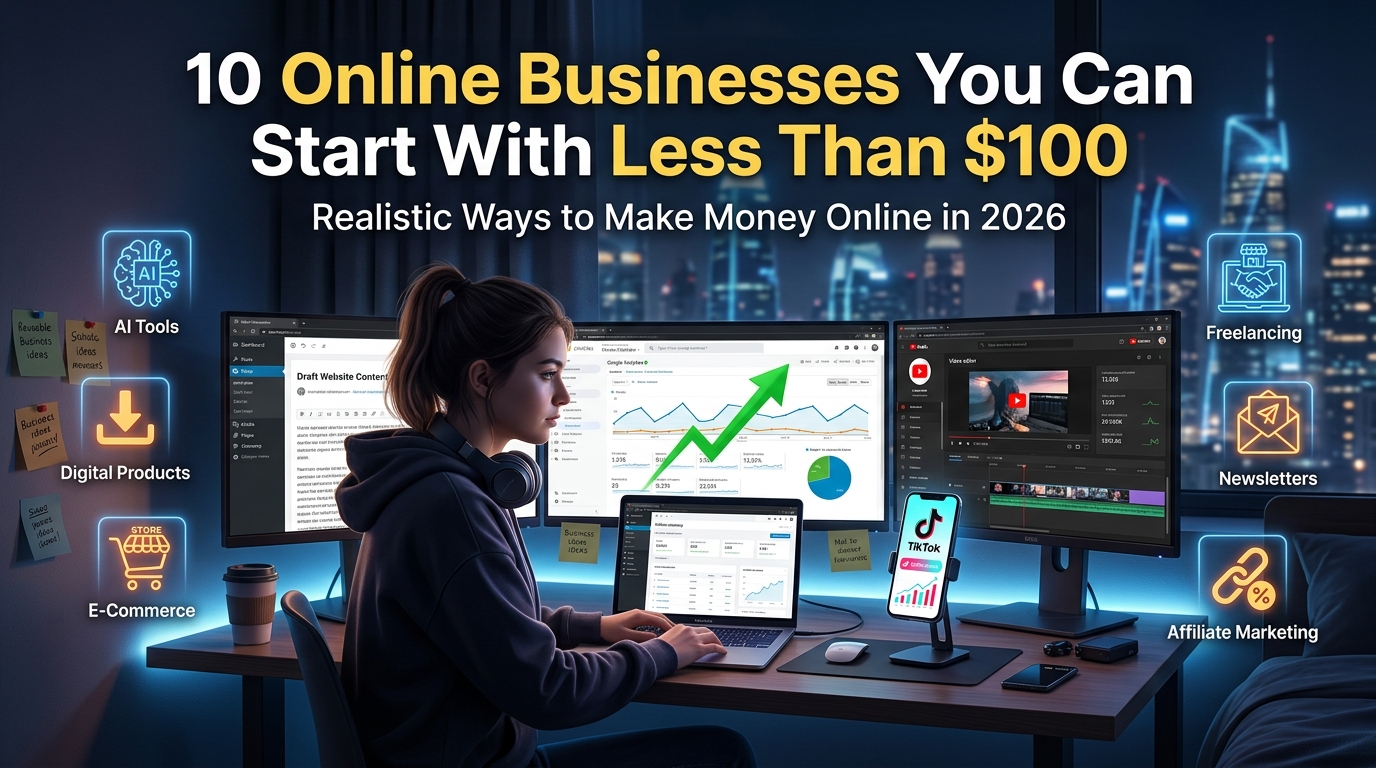
Starting an online business no longer requires a warehouse, expensive equipment, or thousands of dollars upfront. In 2026, the biggest advantage is not capital — it’s distribution, attention, and useful skills.
Most beginners waste months chasing “perfect” business models while ignoring the simpler truth:
The fastest online businesses usually start with selling a skill.
The most scalable businesses usually start with building an audience.
If you only have a small budget, focus on business models with:
- low overhead
- high margins
- digital delivery
- growing demand
- skill-based leverage
Here are some of the most realistic online businesses you can start with under $100 — including what actually works, where beginners struggle, and which models have the best long-term potential.
1: AI-Assisted Content Services
Despite the hype around AI replacing writers, businesses still need humans who can organize information, understand customers, and publish useful content consistently.
That’s why AI-assisted content services are growing quickly.
You are not just “using ChatGPT.”
You are helping businesses publish faster and cheaper.
Services you can offer:
- blog articles
- LinkedIn posts
- SEO updates
- email newsletters
- product descriptions
- website copy refreshes
A lot of local businesses still have outdated websites from 2021–2023. Some have terrible SEO structures, weak headlines, or inactive blogs. Even small improvements can create value for them.
Startup costs are low:
- domain + hosting
- portfolio website
- optional AI subscription
- outreach tools
Realistically, your first clients will probably come from:
- cold emails
- LinkedIn networking
- referrals
- freelance platforms
Many beginners fail because they try to target “everyone.”
You will usually get clients faster by choosing one niche.
For example:
- dentists
- restaurants
- real estate agents
- law firms
- SaaS startups
That makes your service easier to position and easier to trust.
2: Niche Blogging Still Works — But Generic Blogs Don’t
A lot of people claim blogging is dead.
What’s actually dead is low-quality blogging.
The internet is flooded with shallow AI-generated articles that repeat the same advice without experience or original insight. Search engines are increasingly rewarding websites that demonstrate real expertise, practical knowledge, and useful information gain.
That creates an opportunity.
Small niche websites still perform well when they focus on:
- specific problems
- underserved audiences
- firsthand insights
- clear search intent
Examples:
- budgeting apps for African students
- AI tools for teachers
- CRM software for small salons
- freelancing guides for beginners in Africa
Those topics are more specific and less competitive than broad “make money online” blogs.
The mistake many beginners make is expecting fast income.
Blogging is usually slow at the beginning. Some sites make almost nothing for months. But once traffic compounds, it becomes one of the most scalable digital assets you can own.
Monetization options:
- display ads
- affiliate marketing
- sponsorships
- digital products
- consulting
The best blogs today feel less like content farms and more like trusted publications.
3: Faceless YouTube Channels
This model exploded because attention is shifting toward video faster than ever.
You no longer need expensive cameras or a huge team to start.
Many successful channels now use:
- screen recordings
- motion graphics
- stock footage
- AI-assisted editing
- voiceovers
Good niches:
- tech explainers
- AI tutorials
- business breakdowns
- productivity
- finance education
- software reviews
But there’s something most “gurus” ignore:
Uploading videos is not the hard part anymore.
Getting attention is.
Thousands of channels fail because the videos feel generic. The channels that grow usually have:
- strong storytelling
- good thumbnails
- clear hooks
- audience retention
- consistency
Even simple educational channels can work if they solve a clear problem better than competitors.
One advantage of YouTube over short-form platforms is longevity. A good video can continue generating traffic for years.
4: Selling Digital Products
Digital products are attractive because there’s no inventory, shipping, or manufacturing.
You create once and sell repeatedly.
Examples:
- Notion templates
- resume templates
- AI prompts
- budgeting spreadsheets
- Canva packs
- ebooks
- mini-guides
But many beginners create products nobody actually wants.
The smarter approach is:
- build audience first
- identify repeated problems
- create products around those problems
For example, if people constantly ask:
“How do I organize my freelance clients?”
You could create:
- a freelancer dashboard
- proposal templates
- invoice systems
- onboarding checklists
That’s far more effective than randomly uploading generic templates online.
Small useful products often outperform huge complicated ones.
5: Freelance Skill Agency
This is still one of the fastest ways to generate online income.
You start alone, then gradually outsource parts of the work.
Skills that still have strong demand:
- video editing
- web design
- SEO
- thumbnail design
- short-form content editing
- AI workflow setup
- social media management
A lot of businesses know they need online visibility, but they do not have time to manage content consistently.
That creates opportunity for small operators.
One overlooked truth:
Many businesses care more about reliability than perfection.
If you answer messages quickly, communicate clearly, and deliver on time, you already outperform many freelancers.
This business model also teaches real-world client skills:
- communication
- negotiation
- pricing
- systems
- retention
Those skills compound over time.
6: Affiliate Marketing
Affiliate marketing still works, but the easy era is gone.
Random spam blogs and copied product reviews are struggling badly.
Modern affiliate marketing works better when paired with:
- SEO
- YouTube
- TikTok
- newsletters
- niche communities
The strongest affiliate businesses build trust first.
For example:
A creator teaching productivity tools can naturally recommend:
- software
- AI tools
- note-taking apps
- automation platforms
That converts better because the recommendations fit the audience.
The biggest mistake beginners make is promoting too many unrelated products. That destroys credibility.
Trust converts better than aggressive selling.
7: TikTok Theme Pages
Short-form content is still one of the fastest ways to grow an audience from zero.
Pages focused on:
- AI tools
- motivation
- business facts
- tech news
- productivity
- online income
can grow quickly if the content is engaging.
But there’s a major difference between viral content and profitable content.
Some pages get millions of views but make almost nothing.
The smarter strategy is building a niche audience that trusts your recommendations.
That audience can later monetize through:
- affiliate products
- sponsorships
- digital products
- coaching
- newsletters
Attention without trust is unstable.
Trust with even a small audience can become a business.
8: Online Courses
The online education industry is becoming more practical.
People are less interested in massive 20-hour theory courses and more interested in:
- quick implementation
- beginner-friendly systems
- practical walkthroughs
Good beginner course ideas:
- Canva basics
- budgeting
- Excel
- freelancing
- content creation
- AI tools for business owners
You do not need a studio setup anymore.
Many successful creators use:
- screen recordings
- slides
- simple audio
- demonstrations
What matters most is clarity and usefulness.
A small course solving one painful problem can outperform a giant course filled with fluff.
9: Newsletter Businesses
Email newsletters are becoming valuable again because creators want direct access to audiences instead of depending entirely on algorithms.
A newsletter audience is owned traffic.
Topics that continue growing:
- AI updates
- startup trends
- business strategy
- remote work
- investing basics
- creator economy news
Newsletters monetize well because trust is high.
Even relatively small newsletters can earn through:
- sponsorships
- affiliate partnerships
- premium memberships
- consulting offers
The strongest newsletters usually feel personal and opinion-driven rather than corporate.
10: Print-on-Demand Brands
Print-on-demand is harder than it looked a few years ago, but niche-focused brands still work.
The biggest mistake is creating generic designs.
Broad motivational quotes are extremely saturated.
Smaller communities often perform better:
- coding humor
- startup culture
- African identity
- gym culture
- gaming niches
Successful print-on-demand brands usually win through branding and audience connection rather than the product itself.
Marketing matters more than the hoodie.
Which Businesses Make Money Fastest?
Usually:
- freelancing
- video editing
- content services
- social media management
- web design
These models generate cash flow faster because clients already have demand.
Which Businesses Scale Best Long-Term?
Usually:
- blogs
- YouTube channels
- newsletters
- digital products
- affiliate businesses
These take longer, but they become assets over time.
A Smarter Strategy for 2026
Instead of relying on one platform, many successful creators now combine multiple systems together.
Example:
- start a niche blog
- post clips on TikTok
- grow a YouTube channel
- collect emails
- later sell digital products
That creates diversification.
Because algorithms change. Platforms change. Trends change.
Owning your audience matters more than chasing short-term virality.
Final Thoughts
Most online business advice online is either:
- unrealistically optimistic
- overly complicated
- or designed to sell courses
The reality is simpler.
You do not need:
- a huge budget
- a fancy office
- expensive equipment
You need:
- a useful skill
- consistency
- distribution
- patience long enough to improve
The internet still rewards people who solve problems well.
The challenge is not whether opportunities exist.
The challenge is staying consistent long enough to become good at one thing.