






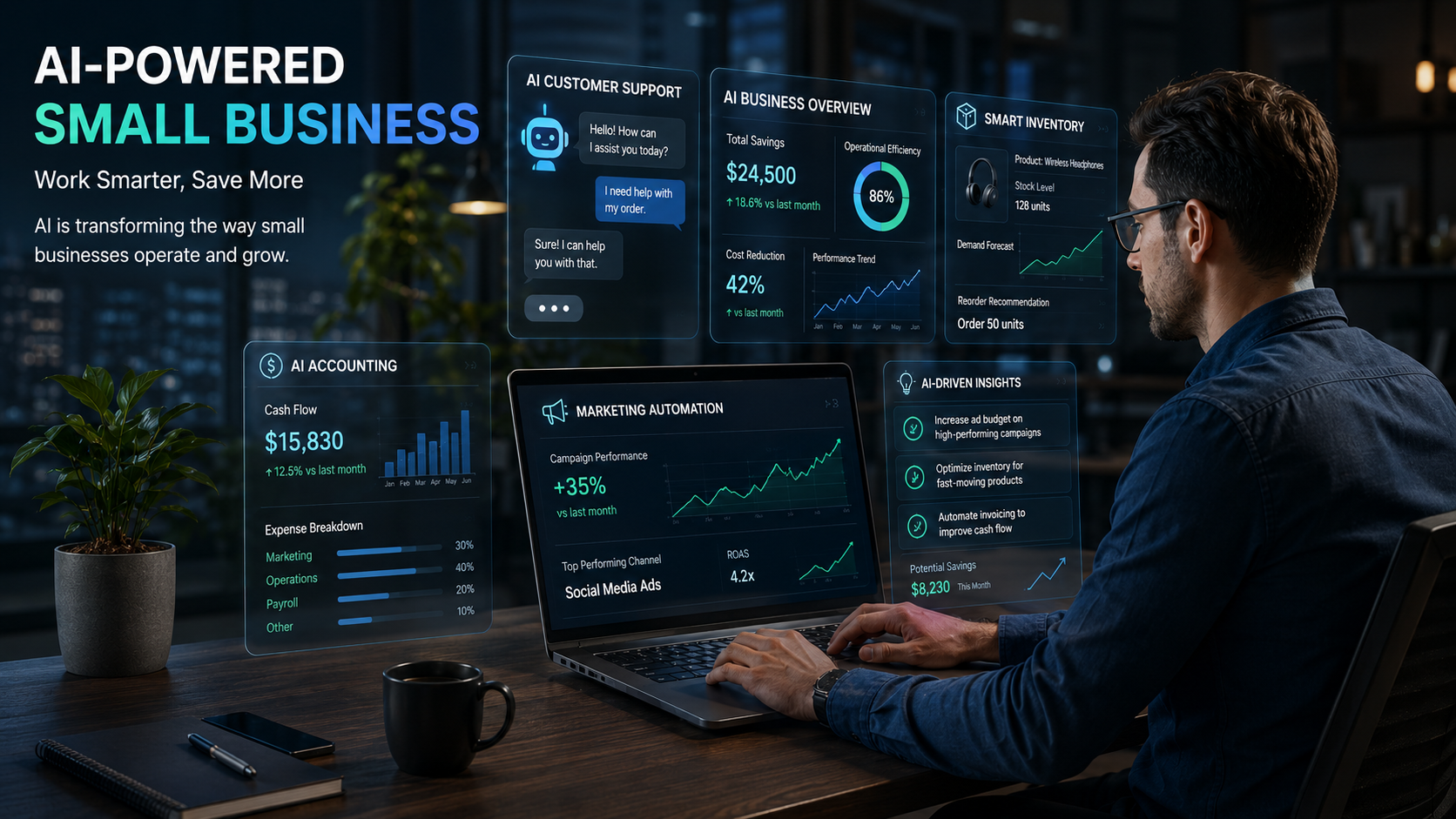
A friend of mine runs a small physiotherapy clinic in Richmond, Virginia — four treatment rooms, two physiotherapists, and until recently, one very overwhelmed receptionist named Grace who spent half her day answering the same three questions: What are your hours? Do you take NHIF? Can I book for Saturday?
Grace isn’t gone. But she no longer spends her mornings on those questions. An AI chatbot on WhatsApp handles them now, around the clock, in a way that sounds natural enough that most patients don’t realize they’re not talking to a human — at least not for the first exchange.
That’s the real story of AI in small business right now. Not robots replacing workers. Not Silicon Valley fantasy. Just a clinic in Westlands that stopped missing Saturday booking requests.
Here’s how it’s actually playing out across different types of small businesses.
1: Customer support: The 2am question problem
Every service business has the same silent revenue leak: inquiries that come in at odd hours, sit unanswered overnight, and by morning the customer has already booked someone else.
AI chatbots — deployed through tools like Tidio, Freshdesk, or even a well-configured WhatsApp Business account — handle the first layer of those conversations. FAQs, appointment availability, pricing, order status. The kinds of questions that don’t require judgment, just information.
What’s realistic to expect? Based on case studies published by Intercom and Freshdesk, businesses typically see AI resolve somewhere between 40% and 60% of incoming support queries without any human involvement. The rest escalate to staff — but now staff are spending their time on conversations that actually need them.
The clinic example above is real. The receptionist now uses her mornings for patient intake, billing follow-ups, and the kind of warm check-in that builds loyalty. The AI handles volume. The human handles nuance.
2: Bookkeeping: The 10 hours that shouldn’t exist
Ask most small business owners what they hate most about running their business and bookkeeping is usually in the top three. It’s not complicated — it’s just relentlessly time-consuming and easy to get wrong when you’re tired.
AI-powered accounting tools like QuickBooks’ automated categorization, Xero’s bank reconciliation, or tools like Dext (formerly Receipt Bank) for receipt scanning have quietly compressed this burden significantly. What used to take a business owner or part-time bookkeeper 8 to 10 hours a month now often takes 1 to 2 hours of review and exception-handling.
The key word is review. The AI does the mechanical work — matching transactions, flagging anomalies, generating summaries. A human still signs off. That’s the right model: not automation replacing judgment, but automation clearing the path so judgment is applied where it actually matters.
For businesses that previously paid a bookkeeper a few hours a week just for data entry, this is where some of the most concrete savings show up.
3: Marketing content: The blank page problem
Creating consistent content — social media posts, email newsletters, product descriptions — is one of those tasks that sounds simple but reliably eats hours every week for small businesses that don’t have a dedicated marketer.
AI writing tools (ChatGPT, Jasper, Canva’s AI features) have changed this, but perhaps not in the way people expect. The best use isn’t “write my social posts for me and publish them.” It’s “give me a first draft I can edit in 10 minutes instead of starting from scratch.”
A small Nairobi-based skincare brand that sells through Instagram described their workflow like this: they use AI to generate five caption options for each product photo. A human — usually the founder — picks one, tweaks the voice, adds something personal, and posts. What used to be a 40-minute task per post is now about 8 minutes.
The content doesn’t sound AI-written because it isn’t, by the time it goes out. It sounds like the founder, because she’s still editing it. AI just removed the friction of starting.
4: Lead follow-up: The speed problem
There’s a well-documented pattern in sales: the faster you follow up with an inquiry, the more likely you are to convert it. Research from Harvard Business Review and others has shown that leads contacted within five minutes are dramatically more likely to become customers than leads contacted an hour later — let alone the next morning.
Most small businesses can’t staff for that response speed. AI-powered CRM tools can.
Systems like HubSpot’s free CRM tier, Zoho, or tools like GoHighLevel can automatically send a follow-up message the moment a form is submitted, ask a qualifying question, and schedule a call — all without anyone touching it. The salesperson picks up when there’s a warm, interested human on the other end, not a cold lead who’s already half-forgotten they submitted anything.
For service businesses — contractors, consultants, cleaners, coaches — this is often where the biggest revenue impact from AI shows up. Not cost savings, but conversion improvement that was being lost to slow response.
5: Inventory: Stopping the slow bleed of overstock
Retailers and wholesalers often carry what I’d call “optimistic inventory” — stock ordered based on gut feel or last year’s numbers, that then sits on shelves, ties up cash, and eventually gets marked down at a loss.
AI demand forecasting isn’t magic, but it’s better than gut feel. Tools like Inventory Planner, or the AI features built into platforms like Shopify and WooCommerce, look at sales velocity, seasonality, and trends to suggest reorder quantities that are actually defensible.
A small hardware supplier I spoke with started using an AI reorder tool last year. His main observation: “It doesn’t have a salesperson who wants him to buy more.” The AI suggests what the data suggests. That neutrality, he said, cut his overstock by about 20% in the first six months, which freed up meaningful working capital.
6: Scheduling: Hours that disappear into admin
For appointment-based businesses — salons, clinics, tutors, personal trainers, repair services — scheduling is one of those tasks that sounds simple but routinely takes 30 to 60 minutes a day in calls, confirmations, and rescheduling.
Tools like Calendly, Acuity Scheduling, or even Google Booking have essentially automated this entire workflow. Clients book their own appointments, receive automatic reminders (which reduce no-shows meaningfully — typically by 20 to 30% based on vendor case studies), and reschedule themselves without calling.
The hidden win isn’t just time. It’s that the business is bookable at midnight. The human doesn’t need to be awake to take the appointment.
7: The “AI stack” replacing one admin hire
This is where things get interesting for businesses at the growth edge — typically companies of 3 to 10 people considering whether they need to hire an administrator.
Several tools combined can do what a part-time admin does: Otter.ai or Fireflies for meeting notes and summaries, ChatGPT or Claude for drafting emails and proposals, Zapier for automating repetitive handoffs between apps, and a scheduling tool for calendar management. The total cost of that stack is usually $100 to $200 per month. A part-time hire in most cities costs significantly more.
This isn’t a case for never hiring. People are better at building relationships, handling exceptions, and doing work that requires genuine judgment. But for the administrative coordination layer — the meeting recaps, the follow-up emails, the document organization — small businesses are increasingly finding they can delay that hire by 12 to 18 months while still staying on top of operations.
What actually works (and what doesn’t)
The pattern across businesses that are getting real value from AI is pretty consistent:
They started with one specific, repetitive problem. Not “we’re implementing AI.” More like: “We’re tired of manually entering every invoice into QuickBooks.” They solved that one thing. Then they looked for the next thing.
The businesses that struggle are the ones trying to build ambitious end-to-end automation before they’ve proven out simple wins. Complicated workflows with many handoffs are fragile. Simple automation of a single repetitive task is reliable.
The other common mistake: expecting AI to replace human judgment entirely. The businesses seeing the best results use AI to clear the administrative underbrush so their people can do the work that actually requires being human.
The honest version of the ROI
For most small businesses, AI isn’t transformational on day one. It’s incremental. An hour saved here, a lead not dropped there, a weekend invoice run that now takes 20 minutes instead of two hours.
But those increments compound. A business that saves 8 hours a week across customer support, scheduling, and bookkeeping has effectively added a part-time employee — without the payroll, the management overhead, or the bad days.
That’s the real case for AI in small business. Not the future. Not the hype. Just small, concrete savings that make the business a little less exhausting to run.