






A lot of “make money online” advice sounds exciting until you try it for three months and realize nobody talks about the hard part: getting attention consistently.
I’ve spent years studying online business models, SEO websites, creator economies, affiliate monetization, and AI-driven content systems. One thing becomes obvious very quickly:
Most one-person businesses do not fail because the idea is bad.
They fail because distribution is harder than people expect.
The internet is full of people building products nobody sees.
That’s why the strongest solo businesses in 2026 are not just “products.” They combine:
- audience
- distribution
- search traffic
- trust
- recurring content
- email ownership
The people quietly winning right now are usually doing one thing extremely well in a small niche instead of trying to become the next massive startup.
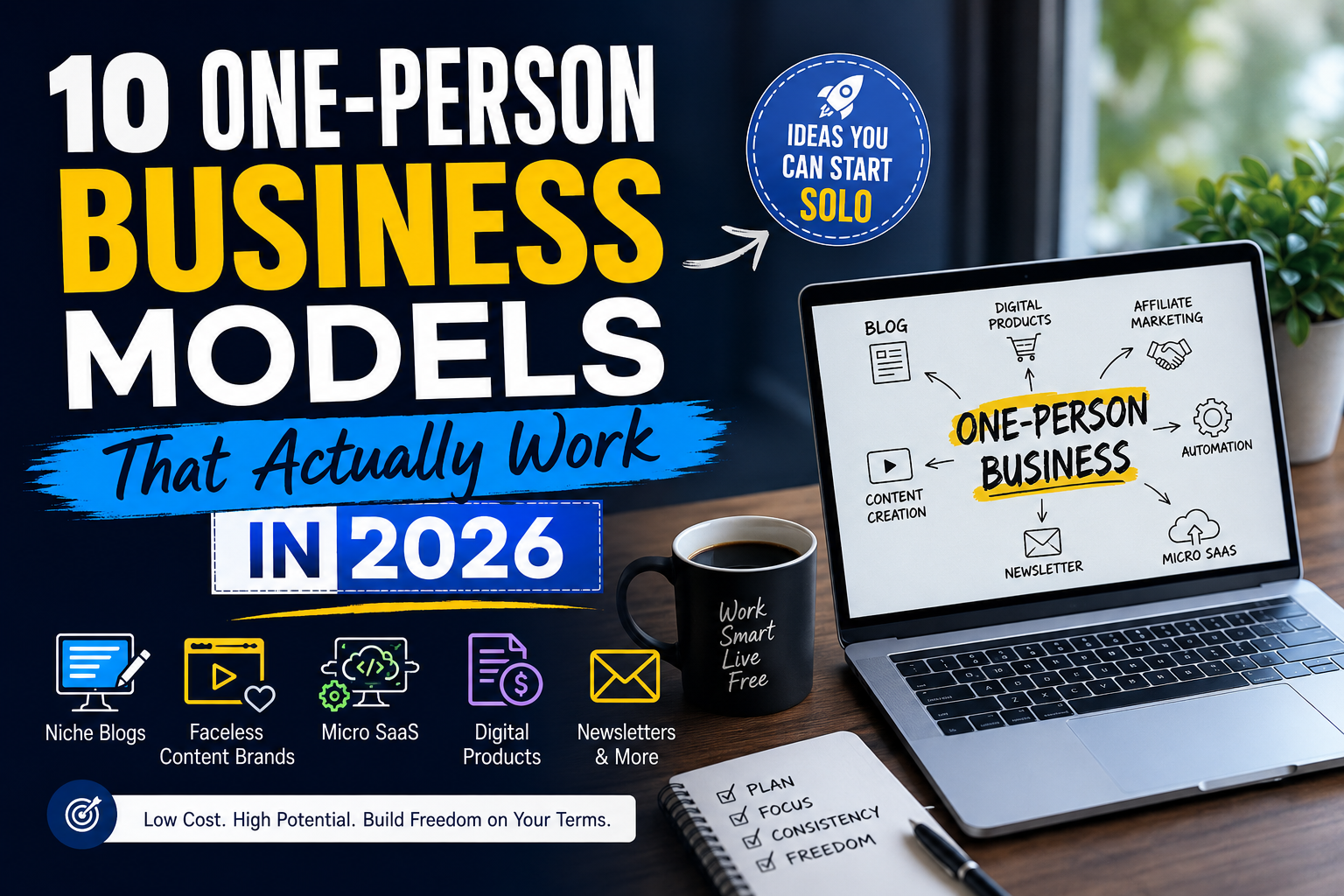
Here are the one-person business models I believe still have real upside — especially for someone interested in AI, finance, content, and digital income.
1. AI-Powered Niche Blogs
This is still one of the most underestimated business models online.
Most beginners make the mistake of creating broad websites about “finance” or “technology.” That almost never works anymore because giant publishers dominate those keywords.
Smaller, highly focused sites are much more realistic.
For example, a site specifically about:
- budgeting for university students in Kenya
- AI tools for lawyers
- ChatGPT workflows for restaurants
- dividend investing for beginners in Africa
can compete much faster because the search intent is narrower.
I’ve seen tiny niche sites with fewer than 50 articles outperform huge websites simply because they answered very specific questions better.
The biggest misconception about blogging is that writing is the hard part. It isn’t.
The hard part is:
- keyword selection
- consistency
- topical authority
- patience
Most sites earn almost nothing for the first 6–12 months. That’s the reality nobody on YouTube likes to mention.
But once search traffic compounds, the economics become powerful because articles keep working long after they’re published.
Monetization usually comes from:
- Google AdSense
- affiliate partnerships
- digital products
- sponsorships
- newsletters
The best part is leverage. One well-ranking article can generate traffic for years.
2. Faceless Short-Form Content Brands
Short-form content is still massively underpriced attention.
The reason this model works is simple:
Platforms reward consistency more than production quality.
Some of the fastest-growing finance and AI accounts today are literally:
- stock footage
- captions
- voiceovers
- simple editing
No expensive cameras.
No office setup.
No team.
A creator posting daily “AI tool breakdowns” or “investing mistakes beginners make” can realistically build an audience much faster than a traditional blog.
But there’s an important catch:
Short-form content without a backend business is fragile.
I’ve watched creators get millions of views while making almost no money because they relied entirely on platform payouts.
The smarter strategy is using short-form content to feed:
- an email list
- a niche website
- affiliate products
- consulting
- digital products
Platforms that still offer major reach:
Attention without ownership is risky.
That’s why email lists matter so much long term.
3. Micro SaaS (But Only If You Solve Real Pain)
Micro SaaS gets romanticized online.
People imagine:
“small app = passive income.”
In reality, most Micro SaaS products fail because founders build tools nobody urgently needs.
The winners usually solve:
- repetitive business tasks
- expensive inefficiencies
- painful workflows
For example:
- invoice automation
- AI meeting summaries
- WhatsApp customer support systems
- local business scheduling tools
The advantage in 2026 is that building software is dramatically easier than before.
You no longer need a full engineering team to launch an MVP.
Tools like:
allow solo founders to build surprisingly capable products.
But distribution is still king.
I’d actually argue most people should build an audience before building software.
A newsletter with 5,000 engaged readers is often more valuable than a random SaaS nobody knows exists.
4. Digital Products
Digital products remain one of the cleanest online business models because there’s no inventory, shipping, or fulfillment complexity.
But the market changed.
Generic ebooks don’t sell well anymore.
Specificity wins now.
For example:
- “AI prompts for real estate agents”
- “Kenyan student budgeting spreadsheet”
- “Notion system for freelance writers”
- “SEO checklist for affiliate bloggers”
Those are much stronger than broad “make money online” products.
One thing I’ve noticed repeatedly:
People buy speed and clarity.
If your template saves someone three hours every week, it has real value.
Platforms like:
make selling extremely accessible for solo creators.
5. Newsletter Businesses
Newsletters are quietly becoming one of the strongest internet assets.
Why?
Because algorithms change constantly.
Email lists don’t.
A creator with:
- 50,000 TikTok followers
but - no email list
is often less secure than someone with:
- 5,000 loyal subscribers
I think many people underestimate how powerful niche newsletters can become.
Examples:
- AI tools for accountants
- African startup funding news
- beginner investing breakdowns
- side hustles using AI
The strongest newsletters usually have:
- a clear niche
- consistent voice
- strong opinions
- useful curation
Not generic summaries.
Tools like:
have lowered the barrier significantly.
6. AI Automation Services
This is probably one of the most practical opportunities right now for solo operators.
Many small businesses know AI matters.
Very few know how to implement it.
That gap is the opportunity.
A solo operator helping:
- clinics
- restaurants
- gyms
- law firms
- ecommerce stores
automate repetitive tasks can build a surprisingly stable income business.
Examples:
- AI chatbots
- automated follow-ups
- appointment reminders
- social media systems
- customer support workflows
The interesting thing is that many businesses don’t even need advanced AI.
Sometimes simple automation creates enormous value.
Tools like:
allow one person to replace hours of repetitive work for a client.
That’s a real business model — not just “content creation.”
7. Affiliate SEO Websites
Affiliate SEO still works despite constant claims that “SEO is dead.”
What changed is:
thin content no longer survives easily.
Google increasingly rewards:
- expertise
- depth
- first-hand experience
- original information
- trust signals
That means generic “Top 10 Best Laptops” articles are becoming harder to rank.
But highly specific comparison content still performs well.
Examples:
- “Best budgeting apps for Kenyan freelancers”
- “Best AI tools for small law firms”
- “Best laptops for finance students”
The sites winning today usually combine:
- topical authority
- useful comparisons
- original screenshots
- personal testing
- expert insight
Affiliate networks include:
The Most Important Shift in 2026
The internet is moving away from:
“anonymous content websites”
toward:
“trusted niche personalities.”
Even faceless brands now need:
- credibility
- opinions
- experience
- consistency
People trust people more than generic websites.
That’s why the strongest strategy today is combining:
- SEO
- short-form content
- newsletters
- audience ownership
- niche expertise
into one ecosystem.
The Business Model I’d Personally Build Today
If I were starting from zero in 2026, I would likely combine:
Main Asset
A niche finance + AI website
Distribution
TikTok + YouTube Shorts
Long-Term Ownership
Email newsletter
Monetization
- affiliate offers
- digital products
- sponsorships
- consulting
- AdSense
This works because every piece strengthens the others.
A blog post becomes:
- tweets
- TikTok scripts
- email content
- Pinterest posts
- YouTube topics
That creates compounding distribution instead of constantly starting from scratch.
And in my opinion, that’s the real advantage of modern one-person businesses:
Not working harder.
Building systems where one idea keeps producing value repeatedly.