





Crypto staking gets marketed as passive income.
Lock up coins, earn yield, compound rewards — simple.
In reality, staking is closer to taking on a bundle of layered risks in exchange for compensation. Sometimes that tradeoff works well. Sometimes the “yield” barely dents the losses from a collapsing token price.
I’ve watched a lot of newer investors focus entirely on APY while ignoring the actual thing generating the return. That’s usually where problems start.
Before staking any crypto, it’s worth understanding what you’re actually being paid for — because the yield is never free.
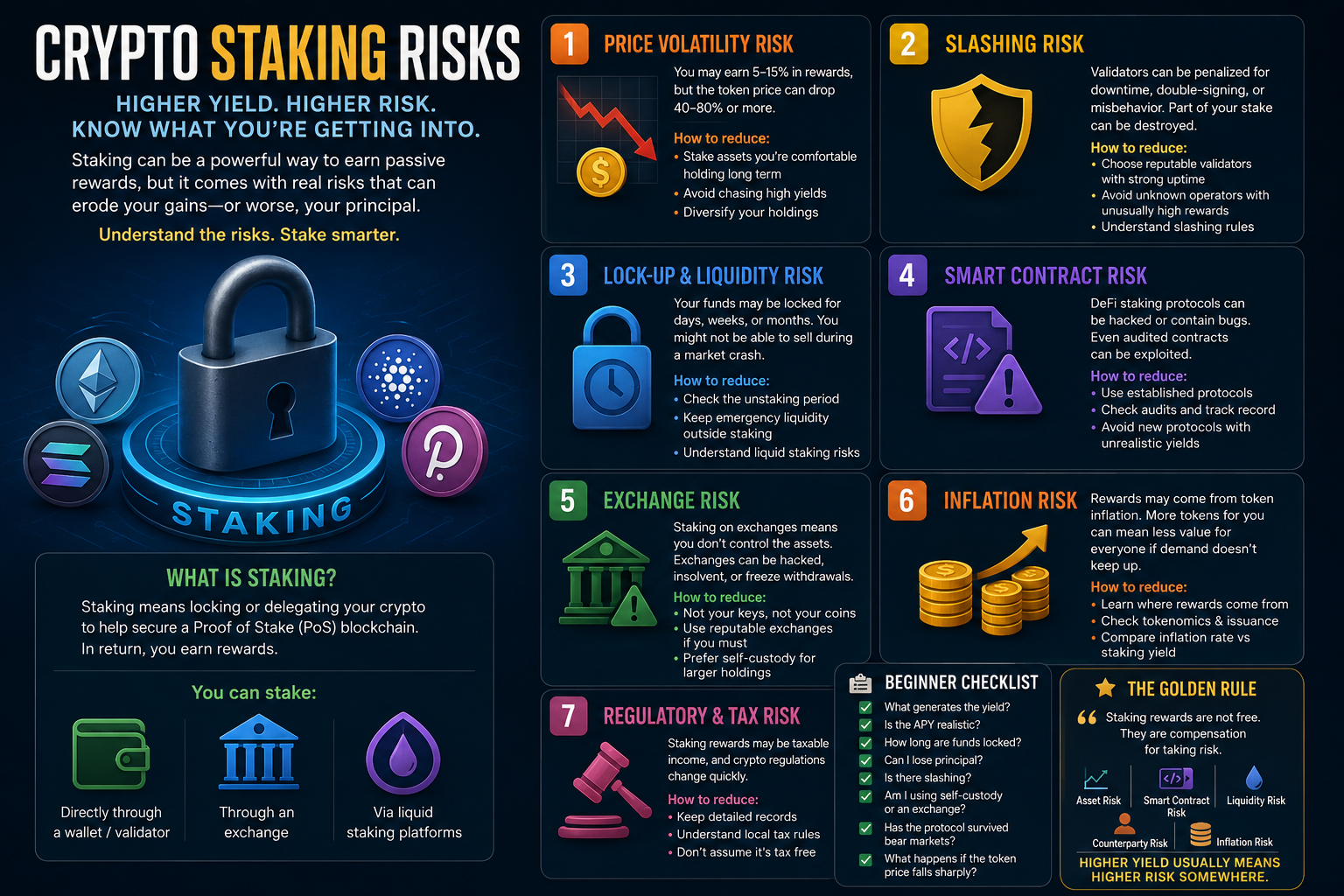
What staking actually is
Most staking happens on blockchains that use Proof of Stake (PoS) systems.
Instead of miners securing the network, validators do. Stakers either lock tokens directly or delegate tokens to validators helping run the chain. In return, the network distributes rewards.
Large staking ecosystems today include:
- Ethereum
- Solana
- Cardano
- Polkadot
There are also multiple ways to participate:
- Native staking through wallets and validators
- Exchange staking through centralized platforms
- Liquid staking through DeFi protocols
Each introduces different risks, and beginners often underestimate how different those risks are.
Staking Ethereum through a hardware wallet is not the same thing as depositing assets into a newer DeFi protocol advertising 70% APY.
Those are completely different risk profiles.
1. Price volatility risk is still the real risk
This is the part beginners consistently underestimate.
People see:
- 6% APY
- 10% APY
- maybe even 15%
and mentally compare it to a savings account.
But staking rewards are paid in the underlying asset — not dollars.
That distinction matters.
I saw this repeatedly during the 2021–2022 cycle. Investors were thrilled earning double-digit yields right up until their token dropped 60–90%. Technically, they earned more coins. Financially, many still lost substantial value.
Example:
- You stake $1,000
- You earn 8% annually
- The token falls 50%
You now own more units of the asset, but your portfolio value is still deeply underwater.
The APY didn’t protect you from asset risk.
That’s why experienced participants usually evaluate the asset first and the staking yield second.
How I think about reducing this risk
- I only stake assets I’d be comfortable holding without rewards
- I treat unusually high yields as warning signs, not opportunities
- I care more about ecosystem strength and adoption than headline APY
A sustainable 5% yield on a strong network is often healthier than 80% emissions on a weak one.
2. Slashing risk is small — until it isn’t
Some Proof of Stake networks penalize validator failures.
That can include:
- downtime
- double-signing
- operational mistakes
- malicious behavior
When this happens, part of the staked funds can be slashed.
For smaller delegators, the direct losses are often limited, but slashing tells you something important: validator quality matters.
A surprising number of people delegate purely based on advertised rewards without checking validator history, infrastructure reliability, or concentration risk.
That’s dangerous.
In practice, reliable validators usually prioritize:
- uptime
- stable infrastructure
- long-term reputation
The validators advertising the absolute highest returns are not always the ones you want securing your assets.
What I personally look for
- Long operational history
- Consistent uptime
- Transparent communication
- Reasonable commission structure
- Evidence they actively maintain infrastructure
If a validator looks anonymous, overpromises rewards, or barely explains its setup, I move on.
3. Liquidity risk becomes very real during market stress
This catches people off guard in fast-moving markets.
Many staking systems have:
- bonding periods
- cooldowns
- delayed withdrawals
Sometimes you cannot access funds for days or weeks.
That sounds manageable until volatility hits.
I’ve seen investors panic during sharp corrections only to realize their assets were still locked in an unstaking queue.
By the time they regained access, prices had already collapsed further.
That doesn’t mean staking is bad. It means liquidity has value, especially in crypto where markets can move violently in short periods.
Before staking, always ask:
- How long is unstaking?
- Is there a queue?
- Can withdrawal periods expand under network stress?
- What happens during major volatility events?
A lot of people never check.
They should.
4. Smart contract risk is massively underestimated
Liquid staking and DeFi staking platforms introduced enormous convenience to crypto.
They also introduced another layer of risk.
When using protocols like:
- Lido
- Rocket Pool
- other DeFi staking systems
you’re no longer only exposed to the blockchain itself.
You’re exposed to:
- smart contract vulnerabilities
- governance failures
- oracle dependencies
- protocol design flaws
- liquidity dislocations
Even audited protocols can fail.
That’s something newer users often misunderstand about audits. An audit reduces certain risks. It does not eliminate them.
The crypto industry has already seen enough “audited” protocols get exploited to prove that.
My general approach
I heavily favor:
- protocols with long operating histories
- large battle-tested ecosystems
- active developer communities
- transparent governance
And I avoid chasing newly launched protocols simply because yields look attractive.
In crypto, extremely high yields often exist because the risk is hard to price.
5. Exchange staking adds counterparty risk
This became painfully obvious after the collapse of FTX.
A lot of users believed they were safely holding assets while earning staking rewards.
In reality, they had handed custody to a centralized company.
That distinction matters enormously.
When staking through an exchange, you’re exposed to:
- insolvency risk
- withdrawal freezes
- hacks
- regulatory intervention
- operational failures
You may technically own the asset while practically losing access to it.
That’s why the phrase:
“Not your keys, not your coins”
still matters.
For smaller amounts, exchange staking can be convenient. But for larger positions, understanding self-custody becomes increasingly important.
6. Inflation can quietly cancel out your yield
One of the most misunderstood parts of staking is where rewards actually come from.
In many networks, rewards are largely funded through token issuance.
In other words:
- new tokens are continuously created
- supply expands
- stakers receive part of that expansion
That means a 12% staking yield does not automatically equal a 12% real return.
If token inflation is high and demand growth is weak, holders can still lose purchasing power despite earning rewards.
This is why sophisticated investors pay attention to:
- tokenomics
- issuance schedules
- validator emissions
- circulating supply growth
- actual network usage
Not just APY dashboards.
7. Regulatory and tax risk is still evolving
Crypto staking regulation remains inconsistent globally.
Tax treatment alone varies significantly between jurisdictions.
In some countries:
- rewards may count as income upon receipt
- capital gains may apply later when sold
- reporting obligations can become surprisingly complicated
Many investors only realize this after several months of transactions across multiple wallets and protocols.
Keeping records early saves enormous pain later.
I strongly recommend tracking:
- reward dates
- token values at receipt
- transfers
- wallet activity
- unstaking events
from the beginning.
The biggest beginner mistake: chasing absurd APYs
When I see triple-digit APYs, my first assumption is not opportunity.
It’s risk.
Usually some combination of:
- aggressive token inflation
- weak liquidity
- unsustainable incentives
- poor product-market fit
- mercenary capital rotating for short-term rewards
Crypto markets repeatedly cycle through these incentive structures.
They look attractive during hype phases and fragile during downturns.
That doesn’t mean every high-yield protocol is fraudulent. But it does mean yields should always raise a question:
Why does this protocol need to pay capital this aggressively?
That question matters more than the headline number.
What I consider more reasonable beginner staking approaches
For most newer participants, the safer path is usually boring:
- stake major established networks
- start small
- prioritize security over yield
- learn self-custody gradually
- avoid overexposure to experimental protocols
There’s a reason many beginners start with:
- Ethereum
- Solana
- Cardano
The infrastructure is more mature, validator ecosystems are deeper, and operational risk is easier to evaluate compared to tiny emerging chains.
Questions worth asking before staking anything
Before staking, I’d want clear answers to these:
- Where exactly does the yield come from?
- Is the reward sustainable or inflation-driven?
- What are the lock-up conditions?
- Can principal be lost?
- Is there slashing?
- Who controls custody?
- Has this protocol survived a bear market?
- What happens if liquidity dries up?
- What happens if the token falls 70%?
If those answers are unclear, the risk probably is too.
Final perspective
The healthiest way to think about staking is this:
You are not being handed free yield.
You are being compensated for taking risk.
Sometimes that risk is:
- market volatility
- smart contract exposure
- liquidity constraints
- validator failure
- inflation
- counterparty risk
The yield exists because the risk exists.
Once you understand that, staking becomes much easier to evaluate rationally instead of emotionally.