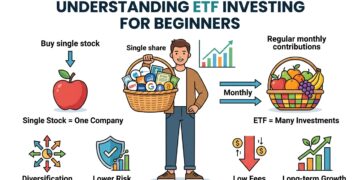






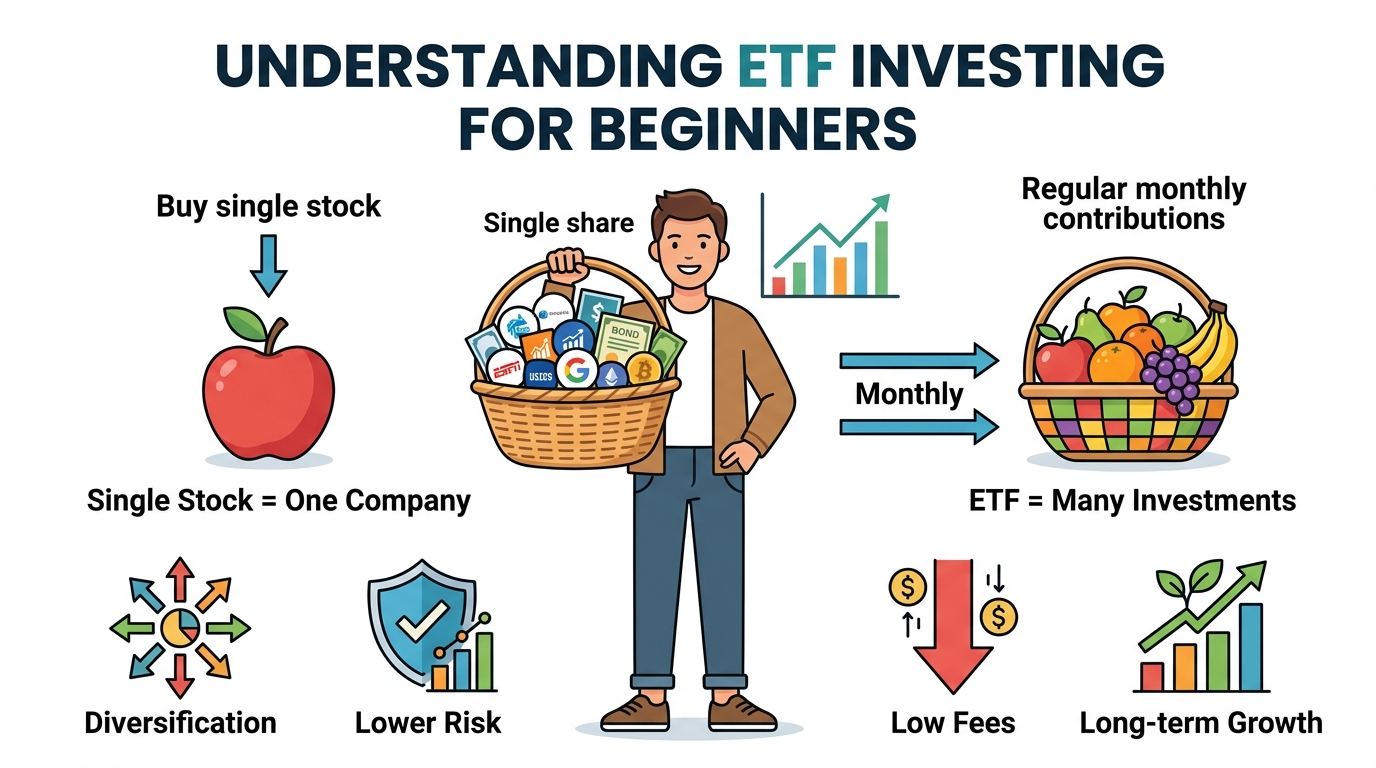
An ETF (Exchange-Traded Fund) is a basket of investments that you can buy and sell on a stock exchange just like a single stock.
Simple analogy
Imagine you want to own fruit:
- Buying a single stock is like buying one apple.
- Buying an ETF is like buying a fruit basket that contains apples, oranges, bananas, and grapes.
If one fruit isn’t doing well, the others may help balance things out.
How ETFs work
An ETF can hold:
- Stocks
- Bonds
- Commodities (such as gold)
- A mix of different assets
For example, an ETF that tracks the S&P 500 owns shares of hundreds of large U.S. companies. When you buy one share of the ETF, you gain exposure to all those companies at once.
Why people like ETFs
✅ Diversification – One purchase can give exposure to many investments.
✅ Lower risk than a single stock – If one company struggles, it usually won’t sink the entire ETF.
✅ Low cost – Many ETFs have very low management fees.
✅ Easy to buy and sell – They trade throughout the day like stocks.
Example
Suppose you have $100:
Option A: Buy stock in one company.
- If the company rises 20%, you gain 20%.
- If it falls 20%, you lose 20%.
Option B: Buy a broad market ETF.
- Your money is spread across many companies.
- Gains may be smaller than the best-performing stock, but losses are usually less severe than betting on a single company.
Common ETF types
- Broad market ETFs – Track an entire market or index.
- Bond ETFs – Invest in government or corporate bonds.
- Sector ETFs – Focus on technology, healthcare, energy, etc.
- International ETFs – Invest in companies outside your home country.
- Dividend ETFs – Focus on companies that pay dividends.
A beginner’s approach
Many long-term investors simply:
- Invest regularly (monthly or quarterly).
- Choose a low-cost, broadly diversified ETF.
- Hold it for many years.
- Reinvest dividends if possible.
This approach avoids trying to pick winning stocks and instead aims to grow alongside the overall market.
Example of long-term growth
If you invest $200 per month into a diversified ETF and earn an average 8% annual return, after:
- 10 years: about $37,000
- 20 years: about $118,000
- 30 years: about $298,000