





Published: June 8, 2026 · Last Updated: June 8, 2026
For most of business history, building a company meant hiring people. A copywriter, a designer, a developer, a customer support agent — each function demanded a salary, and every salary added cost, complexity, and risk. That constraint shaped how businesses were built for over a century.
That constraint is dissolving.
A new class of entrepreneur is building profitable, scalable businesses alone — not by working 80-hour weeks, but by using artificial intelligence as an operational layer that replaces entire departments. The economics are measurable, the tools are mature, and the businesses are real.
This guide covers exactly how the model works, what the numbers show, where it is genuinely working, and — critically — where the risks are that most “AI business” content is too optimistic to name.
What an AI-Powered Solo Business Actually Is

An AI-powered solo business is a company operated primarily by one person who uses artificial intelligence to automate, accelerate, or replace functions that would otherwise require hired staff.
The critical distinction is how AI is used. At the shallow end, it means using AI tools to write emails faster. At the deep end — where the real leverage lives — it means building systems where AI handles entire workflows: client intake, content production, customer communication, and reporting, with the founder only touching exceptions.
The entrepreneur is no longer doing all the work. They are directing the systems that do.
When one solo agency operator first set up an AI-assisted intake and proposal system, the expectation was to save a few hours a week. The actual result was closer to twelve hours a week freed up — not because any single task disappeared, but because the cumulative weight of ten small tasks that each took 20–40 minutes simply stopped requiring the founder’s attention.
What the Data Actually Shows
Before getting into mechanics, it is worth grounding the conversation in what the research actually demonstrates — because the potential and the evidence do not always align.
The productivity gains are real. Federal Reserve research quantified AI’s time savings at an average of 5.4% of work hours — roughly 2.2 hours per week for a full-time worker, or one full workday returned per month. Frequent users gain significantly more: 27% of AI users save over 9 hours per week. For a solo operator, that is the difference between running one business and running two.
The cost reduction is structural. McKinsey’s June 2023 analysis of generative AI’s economic potential sized the long-term opportunity at $4.4 trillion in added productivity growth from AI corporate use cases. For solo entrepreneurs, the same dynamic plays out at a personal level: tasks that previously required paying a specialist can now be handled by a $20/month subscription.
Adoption is accelerating fast. According to McKinsey’s 2025 State of AI survey, 88% of global organizations now use AI in at least one business function — up 10 percentage points from the prior year. Among individual knowledge workers, Worklytics’ 2025 AI Adoption Benchmarks report found that 75% now use AI tools regularly, with adoption nearly doubling in the second half of 2024 alone.
But most people use AI at surface level. The same McKinsey survey found that only 1% of business leaders describe their organizations as having reached AI maturity — defined as AI being fully integrated into operations. The gap between “using AI” and “building a business on AI systems” is the gap this article addresses.
Why This Model Is Growing Now
Several structural forces are converging to make the AI-powered solo business viable at scale for the first time.
The cost of capability has collapsed most visibly. Tasks that required a $60,000-a-year specialist in 2020 — graphic design, copywriting, market research, basic software development — now have AI equivalents accessible for tens of dollars a month. Midjourney handles design concepts. Claude and ChatGPT handle writing and research. GitHub Copilot handles code. A solo operator today can run systems on roughly $180/month in AI subscriptions that would have cost $8,000–$12,000 a month in contractor fees three years ago.
Execution speed has followed. A Stanford and MIT study published in Science (2023) tracked 5,000 customer support agents using an AI assistant and found a 14% average productivity increase across the board, with the biggest gains going to less experienced workers. For a solo founder, compressed execution timelines mean faster product launches, faster iteration, and faster revenue.
The third shift is reach. A solo operator with a laptop and a Stripe account can serve customers in 50 countries without a sales team, a logistics operation, or a physical office. AI handles the customer-facing communication layer that would otherwise require localization specialists and support staff.
The Core Operating Stack
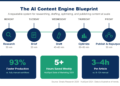
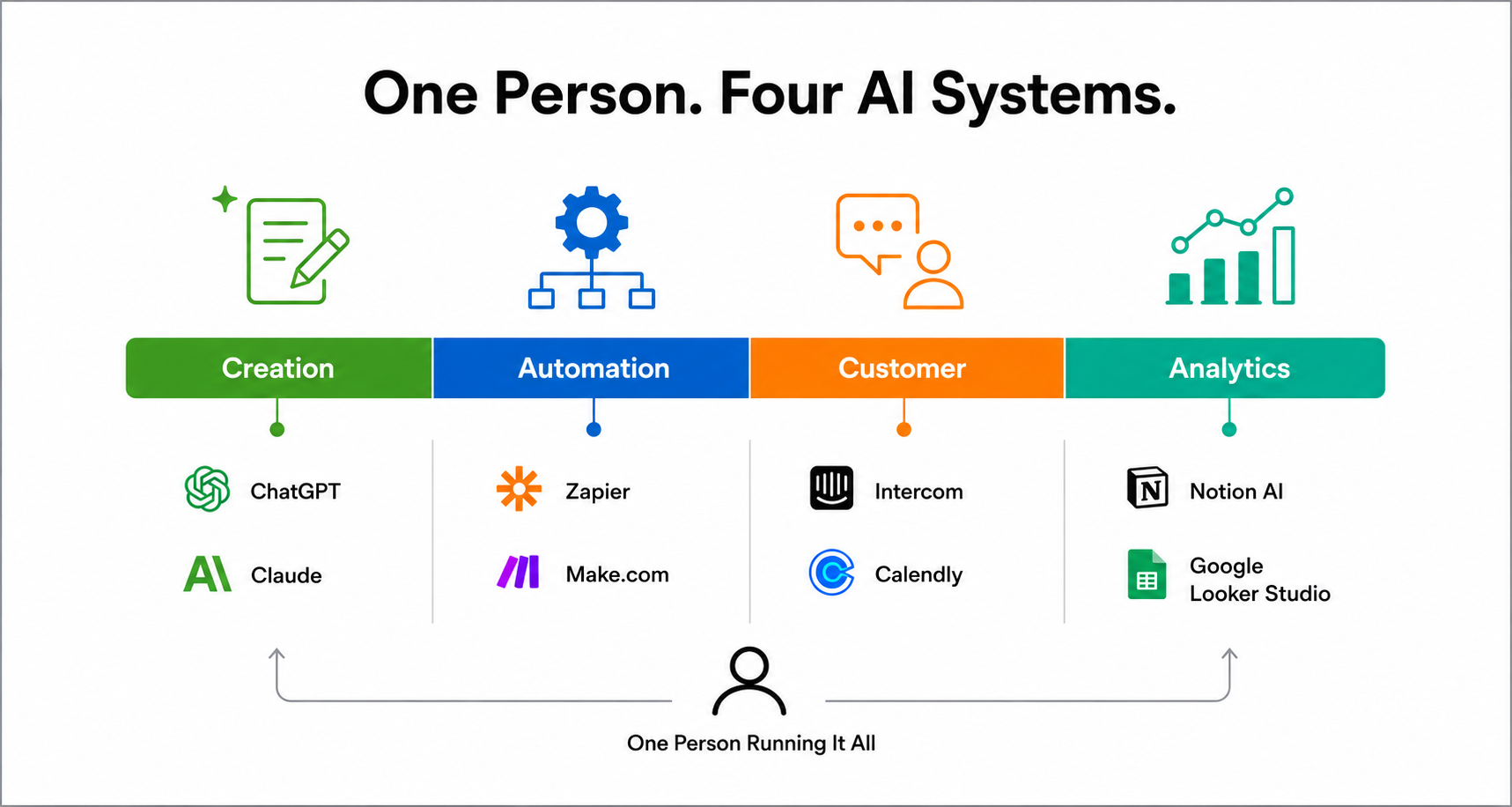
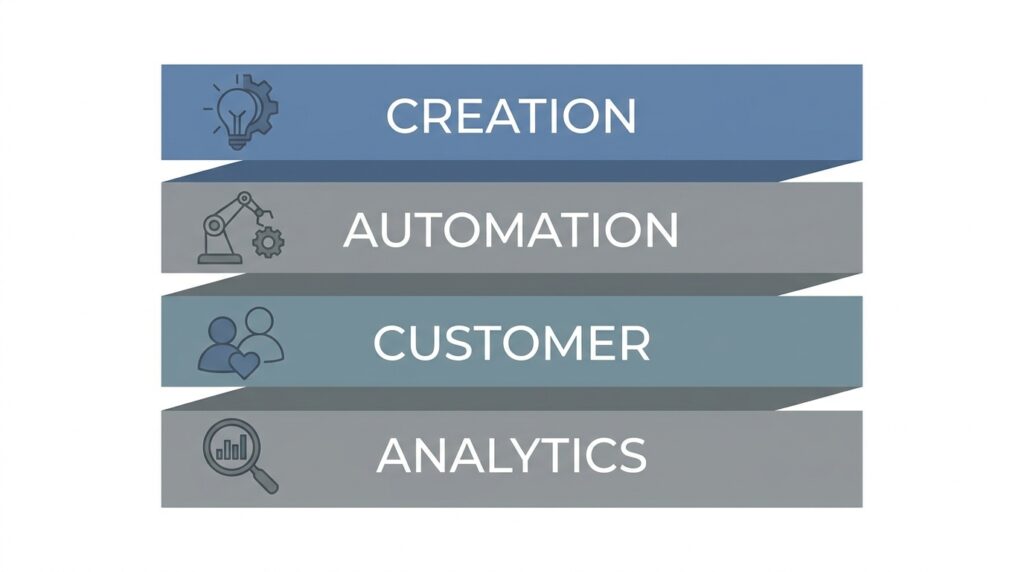
A functional AI-powered solo business typically relies on four layers of tools working in combination. Here is how each layer functions in a real operation, and why it matters.
The creation layer — Claude, ChatGPT, Midjourney, Adobe Firefly, GitHub Copilot — handles the output that would previously require creative and technical staff. In a typical content agency setup, Claude handles first drafts, research synthesis, and brief generation, while the founder edits, shapes the argument, and adds the domain insight that makes the work worth paying for.
Below that sits the automation layer: Zapier, Make.com, and n8n. These tools turn isolated AI outputs into integrated operational pipelines without custom engineering. A client intake-to-proposal flow built on Make.com, for example, can trigger a research brief, a personalized proposal, and a calendar booking link from a single form submission — all without the founder’s involvement.
The customer layer — Intercom with AI assistance, Calendly, Tidio, and similar tools — ensures that customer experience does not degrade as the business grows without headcount. And the analytics layer, built on Notion AI, Airtable, Google Looker Studio, and AI-generated reporting via custom prompts, is how a solo founder maintains operational visibility across a business that processes more volume than they could manually track.
The goal is not to use every tool. It is to identify the highest-friction tasks and eliminate them one by one.
What the Model Looks Like in Practice
Pieter Levels (@levelsio) is the most documented example in this space. He has built multiple profitable software products — including Nomad List and Remote OK — largely alone, using automation and AI-assisted development. As of 2024, he publicly reported generating over $3 million in annual revenue as a solo founder. His model: build fast, automate ruthlessly, avoid hiring until the business genuinely cannot function without it.
At a smaller but highly replicable scale, independent newsletter operators and content businesses have demonstrated the model clearly. Using AI for research synthesis, draft generation, and SEO structuring — while keeping analysis and voice human — solo operators have built audiences of 50,000+ subscribers and generated five-figure monthly revenues with no staff.
A concrete operational workflow illustrates how the pieces connect. When a potential B2B client fills out an intake form, an automated Make.com workflow fires: it pulls their website and LinkedIn data, passes it to Claude with a structured prompt, and generates a personalized proposal email in the founder’s voice — ready for review in under two minutes before sending. If they book a call, a pre-call research brief arrives automatically.
After the call, a voice note is recorded, transcribed, and structured into a project brief. Claude drafts the first content deliverables while the founder edits and applies judgment. Delivery, invoicing, and follow-up run on automation. Active founder time per client: four to six hours per project. Everything else runs on systems.
This is not a hypothetical workflow. It is the described system of multiple solo operators documented publicly in communities like IndieHackers, which tracks businesses generating $10,000–$500,000 per month with zero or near-zero staff.

The Business Models That Work Best
Not every business model is equally suited to the solo AI model. The structures that work best share a common characteristic: high value-per-transaction relative to the time required to fulfill it.
Digital products and SaaS are the clearest fit — software built once and sold repeatedly requires no additional labor per unit sold, and AI dramatically reduces the development and marketing cost of getting to a sellable product. The constraint is finding genuine product-market fit, which AI does not solve.
Professional services with AI-assisted delivery work well for a different reason: the client pays for expertise and output quality, not for hours. Content agencies, marketing consultancies, research services, legal document drafting, financial analysis — all of these benefit from AI increasing output volume without diluting the quality that commands the fee. Solo content agencies operating this model consistently report the leverage as substantial.
Content and media businesses monetized through subscriptions, sponsorships, or courses suit the model because AI handles the research and production layer while the founder’s perspective and judgment remain the differentiating asset. E-commerce and print-on-demand operations fit similarly — AI handles product descriptions, ad copy, customer email, and inventory analysis, while platforms like Printful and Gumroad have built their infrastructure specifically to enable single-person operations at scale.
The Challenges Most AI Business Content Won’t Name
AI-powered solo businesses are not frictionless. An honest assessment includes several hard problems that operators encounter in practice.
Quality drift is the most insidious. AI output degrades when prompts and systems are not maintained — and the degradation is gradual enough to miss. In early 2023, one solo agency operator set up an automated content pipeline for a client and did not audit it for six weeks. When the output was finally reviewed, quality had quietly slipped: the drafts were still structurally correct, but the voice had drifted and the research was thinner than the expected standard. Human review loops are not optional. They are the product.
The automation build-out also takes longer than most founders expect. Most report spending more hours building and maintaining their AI systems in the first six months than they saved. One well-documented example: roughly 80 hours spent in Q1 2023 building and debugging an intake-to-proposal automation, which then saved approximately 10 hours a week once running — with break-even around month four.
Finding customers remains entirely a human problem. AI handles volume and execution, but it does not replace the judgment required to identify a real market need, build trust with early customers, or navigate the commercial conversations that determine whether a business has a future. BCG’s AI adoption research found that 74% of AI-powered initiatives fail to scale, and the cause is almost never the technology — it is the absence of a genuine value proposition or the organizational conditions to deliver it consistently.
The deeper ceiling is domain expertise. AI amplifies output; it does not generate expertise from scratch. A solo founder who deeply understands SEO, accounting, UX design, supply chain, or legal research can use AI to deliver that expertise at dramatically higher volume and lower cost. A founder who has no underlying expertise and hopes AI will substitute for it will produce mediocre output at scale, which is worse than producing less of it.
Finally, the ownership status of AI-generated content remains legally unsettled in most jurisdictions. Founders building businesses on AI-generated content or code should understand the current state of copyright law in their market rather than assume the issue does not apply to them.
The Future of This Model
Gartner projects that by 2028, 33% of enterprise software applications will include agentic AI — up from less than 1% in 2024. The same capabilities that large organizations are beginning to deploy at scale are already accessible to individual founders through the consumer and developer tool market.
The structural implication is significant: the competitive advantage in many service industries is shifting from who has the most people to who has the best systems. A solo operator with strong AI systems and genuine domain expertise can compete on quality and price against agencies with ten employees — not because AI is magic, but because the cost structure is categorically different. Solo operators have won client engagements against five-person agencies on both quality and price. That was not consistently possible in 2020.
This does not mean large teams disappear. It means the minimum viable team for a profitable, professional-grade business is smaller than it has ever been — and that floor is still dropping.
McKinsey’s 2025 State of AI survey found that 92% of companies plan to increase their AI investments over the next three years. The solo founders who build serious, durable businesses from this moment forward will not be the ones most impressed by AI. They will be the ones most disciplined about combining strong human judgment with strong AI systems — and most honest about the difference between the two.
Key Takeaways
- An AI-powered solo business uses AI as an operational layer that replaces functions previously requiring staff — creation, automation, customer management, and analytics.
- The productivity gains are real: Federal Reserve research shows AI users reclaim an average of one full workday per month, with heavy users saving 9+ hours per week.
- Real-world solo operators like Pieter Levels ($3M+ ARR) demonstrate the model works at meaningful scale with no team.
- The business models with the highest fit are digital products, AI-assisted professional services, content businesses, and e-commerce.
- 74% of AI-powered initiatives fail to scale — almost always due to the absence of genuine expertise or market fit, not technology failure.
- AI amplifies output. It does not substitute for domain expertise, customer trust, or sound business judgment.
Sources
- McKinsey & Company — Superagency in the Workplace (2025)
- McKinsey & Company — The Economic Potential of Generative AI (June 2023)
- Brynjolfsson, E., Li, D., & Raymond, L. — Generative AI at Work, Science, 381(6654) (2023)
- Federal Reserve — Research on Generative AI and Worker Productivity
- BCG — Generative AI Enterprise Adoption Report (2024)
- Gartner — Top 10 Strategic Technology Trends for 2025 (2024)
- Worklytics — 2025 AI Adoption Benchmarks
- IndieHackers.com — Solo Founder Revenue Database
- Pieter Levels (@levelsio) — Revenue Disclosures via X (2023–2024)
Frequently Asked Questions
Do I need technical skills to build an AI-powered solo business?
Not necessarily. The core automation tools — Zapier, Make.com, n8n — are designed for non-developers and rely on drag-and-drop logic rather than code. The creation layer tools like Claude and ChatGPT require no technical knowledge at all. Where basic technical comfort helps is in connecting APIs or customising workflows beyond what no-code tools allow, but most solo operators run fully functional systems without writing a single line of code.
How much does it cost to set up the AI tool stack?
A functional stack covering creation, automation, customer communication, and basic analytics typically runs between $150 and $300 per month depending on usage volume and the specific tools chosen. That covers a flagship AI writing tool, one automation platform, and a scheduling or support tool. The cost scales with usage but remains a fraction of what equivalent contractor or staff coverage would cost.
How long does it take before the AI systems actually save time?
Most founders report a build-out period of two to six months before their systems are running smoothly enough to generate a net time saving. The first months often involve more hours spent configuring and debugging than are saved. The break-even point on a well-built intake-to-delivery automation has been documented at around month four, after which the weekly time savings compound indefinitely.