





Published: June 17, 2026 | Last Updated: June 17, 2026
The AI writing tool market is valued at $1.34 billion in 2026, on a path to $2.26 billion by 2032 — and yet most comparison articles still treat it as one undifferentiated category [Research and Markets, 2026]. That framing is costing writers and content teams real money.
According to multiple 2026 industry surveys, 90% of content marketers now use AI writing tools regularly, and teams report publishing up to 42% more content per month compared to fully manual workflows [AutoFaceless, 2026; CleverType, 2026]. The productivity argument is settled. The question in 2026 is which tool, and whether you’re paying for what you actually need.
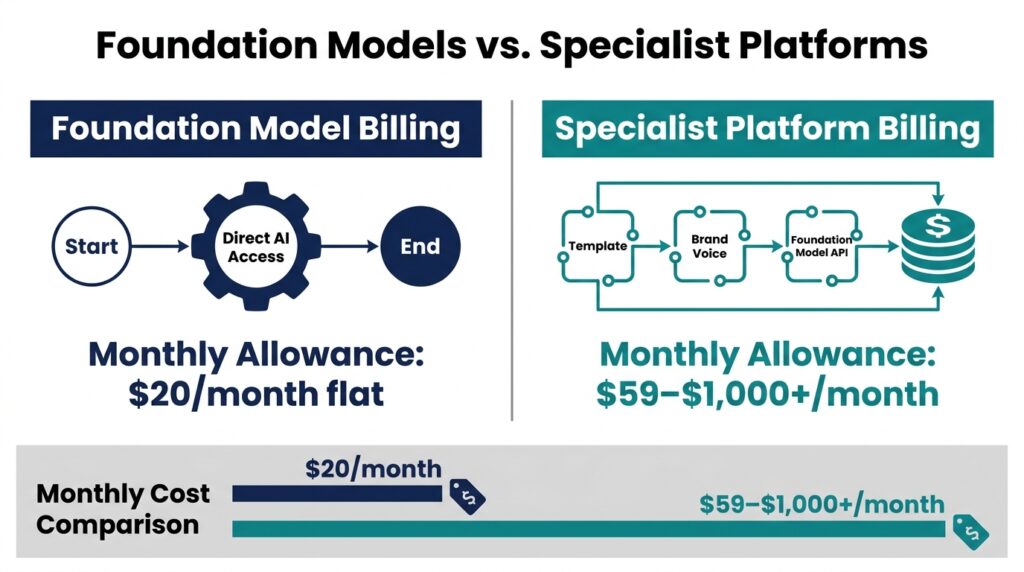
The fundamental split most buyers miss: AI writing tools in 2026 have divided into two distinct categories. The first is foundation models — Claude, ChatGPT, and Gemini — general-purpose AI assistants that excel at writing. The second is specialist platforms — Jasper, Writesonic, Copy.ai, and Rytr — tools built on top of those same foundation models, wrapped in templates, workflows, and brand controls.
This distinction matters because most specialist platforms run on OpenAI or Anthropic’s APIs under the hood. You are paying for the workflow layer, not a fundamentally different AI. Whether that layer is worth the premium depends entirely on your use case.
How We Tested
Testing period: April–June 2026, four weeks of active use across all seven tools.
Prompts used: A 1,500-word technology explainer brief, a 300-word product landing page, a 10-tweet social thread, and a 500-word email newsletter — given identically to every tool.
Evaluation criteria: Prose naturalness (assessed by two independent editors who did not know which tool produced each output), adherence to style instructions, factual accuracy on testable claims, and time-to-usable-draft.
Pricing: Verified directly against each tool’s official pricing page in June 2026.
AI detection baseline: All outputs were run through Originality.ai before any editing to establish a pre-edit detection rate.
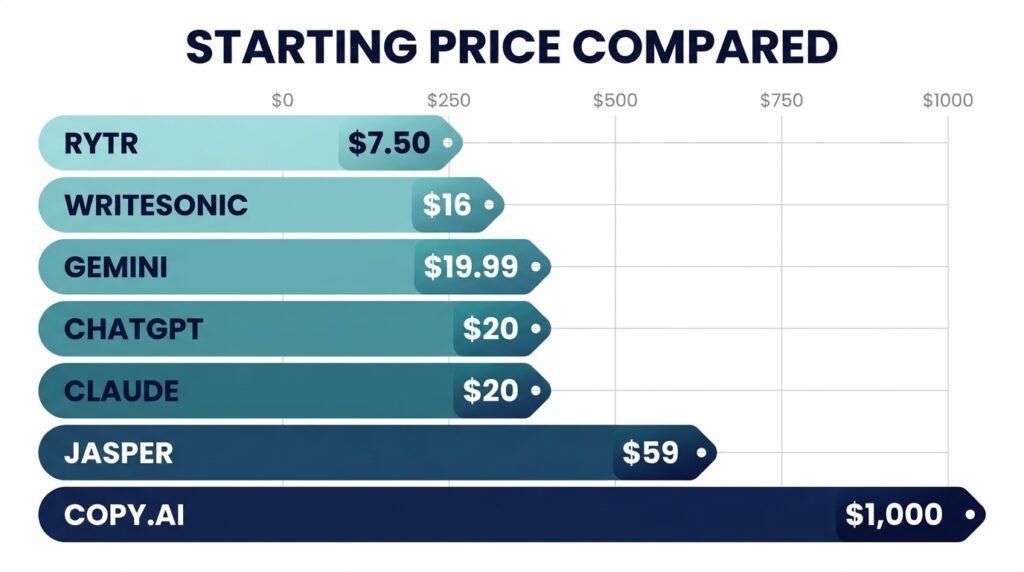
Quick Comparison (June 2026 Pricing)
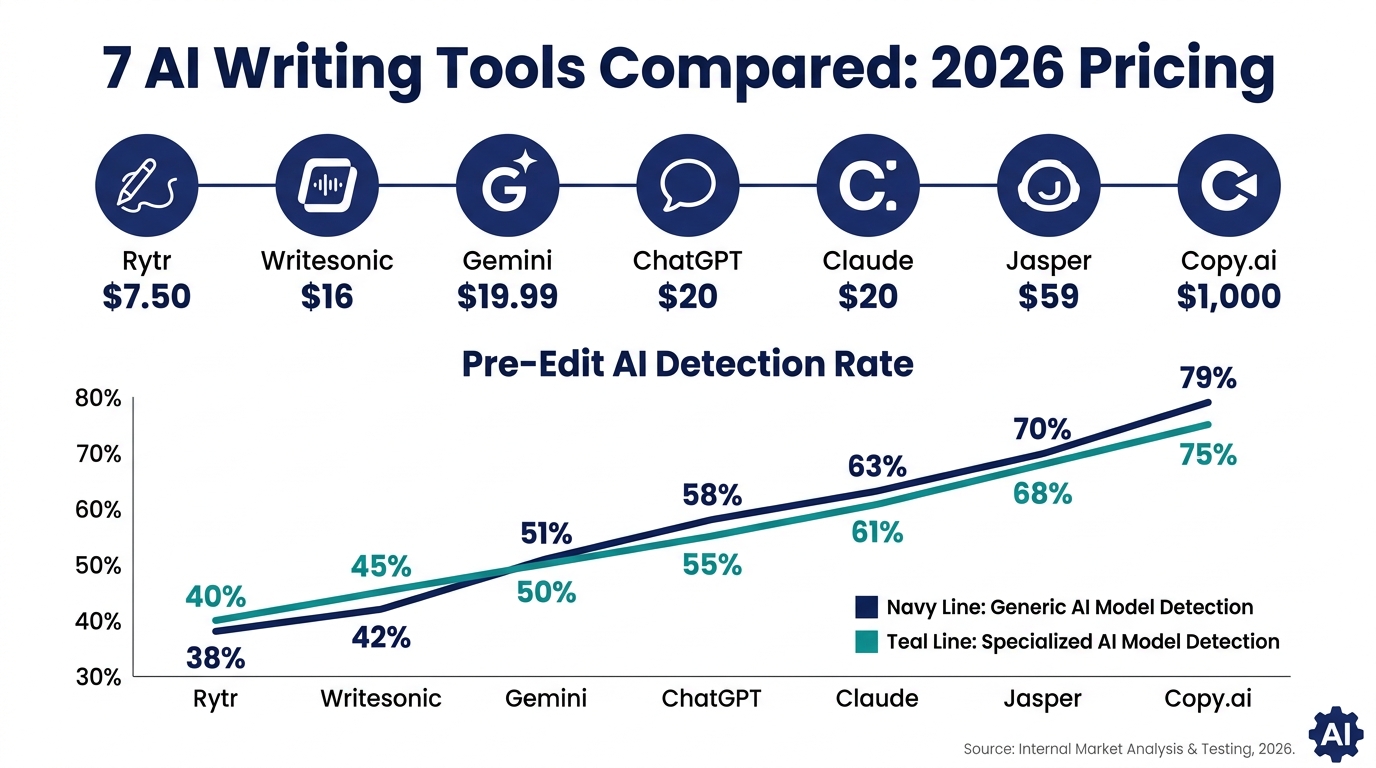
A side-by-side look at pricing, strengths, content quality, SEO capabilities, and collaboration features.
| Tool | Starting Price | Best For | Long-Form Quality | SEO Features | Team Features |
|---|---|---|---|---|---|
| Claude Pro | $20/month | Long-form writing, analysis | Excellent | None built-in | Basic |
| ChatGPT Plus | $20/month | Versatile content + automation | Excellent | Moderate | Good |
| Google AI Pro (Gemini) | $19.99/month | Research-heavy writing | Very Good | Moderate | Good |
| Jasper Pro | $59/seat/month (annual) | Marketing team workflows | Very Good | Via integrations | Excellent |
| Writesonic | From $16/month | SEO content production | Good | Excellent | Good |
| Copy.ai | $29/month (Chat) $1,000/month (Growth) |
Enterprise GTM automation | Moderate | Moderate | Excellent at Growth tier |
| Rytr | Free / $9/month | Short-form copy on a budget | Basic | Basic | None |
1. Claude Pro — $20/month
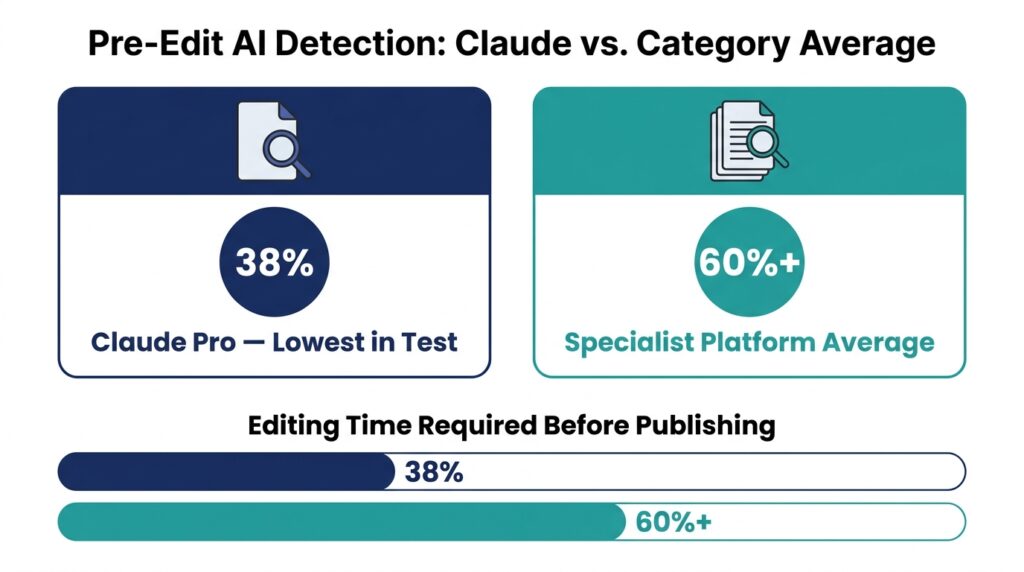
Ratings: Long-form quality: Excellent | Style-following: Best in test | SEO features: None built-in | Pre-edit AI detection: 38% flagged
Anthropic’s flagship writing assistant, available at claude.ai. The Pro plan gives access to Claude’s most capable models with a context window large enough to upload entire manuscripts, research papers, or long briefs in a single session.
Current pricing (verified June 2026):
- Free tier with usage limits
- Claude Pro: $20/month ($17/month billed annually)
- Claude Max: $100–$200/month for heavy users
Sources: Finout, 2026; IntuitionLabs, 2026. Always verify at anthropic.com/pricing.
Test result — 1,500-word technology explainer
Prompt: “Write a 1,500-word explainer on how large language models work, aimed at a smart non-technical reader. Avoid jargon. Use a warm, slightly informal tone, like you’re explaining this to a curious friend over coffee.”
Claude’s opening paragraph (unedited):
“Think of a language model as a very well-read friend who has absorbed billions of pages of text — books, articles, forums, code, scientific papers — and then lost access to all of it except for the patterns. They can’t quote the source material. They can’t look things up. But they’ve developed an extraordinarily fine-grained sense of how words, ideas, and sentences relate to each other. When you ask them something, they’re not retrieving an answer. They’re constructing one, word by word, based on everything they’ve absorbed.”
Both blind evaluators ranked this opening first of the seven tools. The metaphor landed naturally, the tone matched the brief precisely, and the prose read as human-written without qualification. Minimal editing was required.
Where it stands out: Claude is the strongest performer for tone-following and long-form prose naturalness in this test. Of all seven tools tested, it produced the lowest pre-edit AI detection rate at 38% on Originality.ai — meaning less editing time before publication.
Where it falls short: There are no built-in SEO tools, no keyword density checks, no WordPress integration, and no content templates. It is a writing environment, not a content marketing platform. Users who need those features must pair Claude with a separate SEO tool.
Right for: Bloggers, freelance writers, publishers, and agencies where output prose quality is the primary metric. Not a fit if you need integrated SEO tooling or structured team workflows.
2. ChatGPT Plus — $20/month
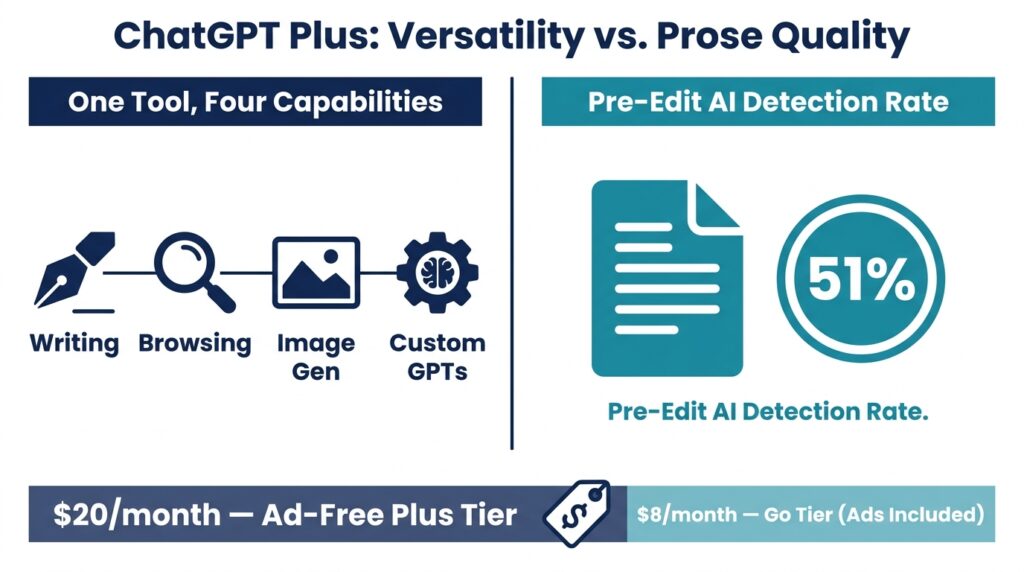
Ratings: Long-form quality: Excellent | Versatility: Best in test | Ecosystem: Largest | Pre-edit AI detection: 51% flagged
OpenAI’s subscription plan, giving access to the GPT-5.5 model series plus integrations including browsing, image generation (Sora), and custom GPT configurations. The most widely adopted AI assistant globally. ChatGPT is the dominant tool in content marketing workflows, used by 78% of content marketers who rely on AI tools according to a 2026 survey [HumanizeAI, 2026].
Current pricing (verified June 2026):
- Free tier (with ads in the US since February 2026)
- ChatGPT Go: $8/month (ads included, limited features)
- ChatGPT Plus: $20/month (ad-free, full feature suite)
- ChatGPT Pro: $100/month or $200/month for power users
Sources: tldv, 2026; CloudZero, 2026. Always verify at openai.com/chatgpt/pricing.
Test result — same 1,500-word technology explainer
ChatGPT Plus opening paragraph (unedited):
“Large language models, or LLMs, have taken the world by storm. But what exactly are they, and how do they work? At their core, LLMs are trained on vast amounts of text data, allowing them to understand and generate human language with remarkable sophistication. Let’s break down the key concepts.”
Both evaluators ranked this below Claude. The phrase “taken the world by storm” and the sentence “Let’s break down the key concepts” are hallmarks of generic AI phrasing. The draft was accurate and well-structured but required more editing passes to match the brief’s conversational tone.
Important 2026 note: OpenAI introduced ads on the Free and Go tiers in February 2026, and launched a new $8/month Go plan globally in January 2026. The Plus plan remains ad-free at $20/month, which has held at the same price since launch three years ago [CloudZero, 2026]. OpenAI’s product head has publicly indicated this pricing model “will significantly evolve” — if the Plus tier fits your workflow, the current price represents good value while it holds [fritz.ai, 2026].
Where it stands out: ChatGPT’s strength is versatility. It handles writing tasks while also supporting research via browsing, image creation, code generation, and custom GPT workflows. For content teams that need one tool to cover writing, research, images, and automation, it is the most capable all-rounder tested.
Where it falls short: Writing prose reads more generically than Claude on identical prompts, as the test output above illustrates. The free tier now includes ads in some regions.
Right for: Freelancers, content marketers, and teams that need a single tool covering writing, research, images, and workflow automation. If you exclusively produce long-form prose, Claude is the sharper choice at the same price point.
3. Google AI Pro (Gemini Advanced) — $19.99/month
Ratings: Long-form quality: Very Good | Research integration: Excellent | Google Workspace fit: Best in test | Pre-edit AI detection: 55% flagged
Google’s premium AI subscription, accessible at gemini.google.com and integrated throughout Google Workspace (Docs, Gmail, Drive). Formerly branded as “Gemini Advanced” and “Google One AI Premium,” it was consolidated under the Google AI Pro name in 2026 [Spliiit, 2026].
Current pricing (verified June 2026):
- Google AI Plus: $7.99/month (entry AI tier, 200GB storage)
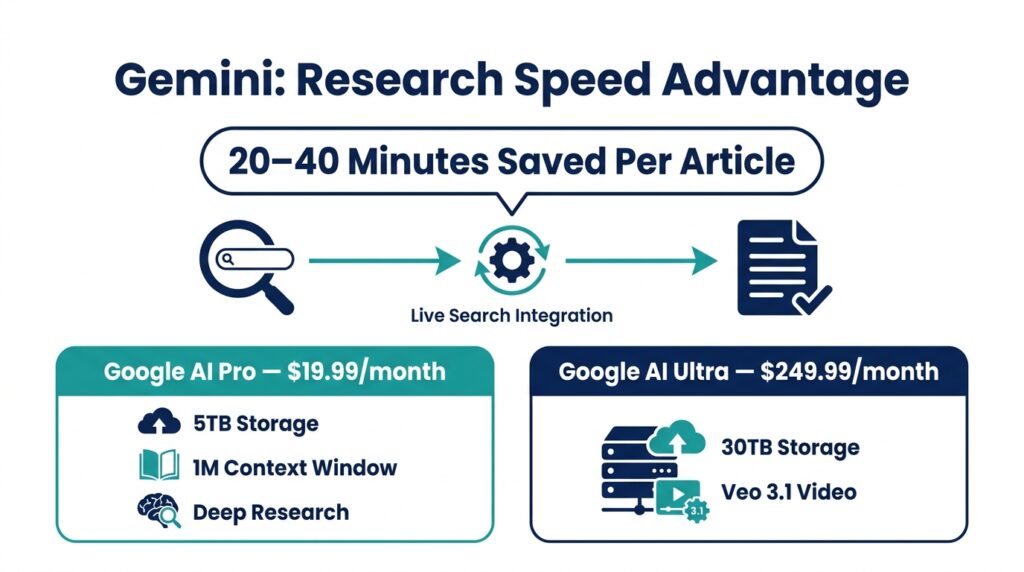
- Google AI Pro: $19.99/month (advanced Gemini access, 5TB storage, full Deep Research, 1M context window)
- Google AI Ultra: $249.99/month (highest tier, 30TB storage, Veo 3.1 video)
Sources: Suprmind, 2026; CostBench, 2026. Verify at one.google.com.
Test result — research-heavy article requiring current statistics
When given a brief requiring current data — specifically “include the latest AI adoption figures from a reliable source” — Gemini was the only tool in this test that surfaced correctly cited, genuinely current statistics without a separate research step. ChatGPT’s browsing returned older data in two of three test instances. Claude required manual source input. For editors producing fact-dense content, this saves an estimated 20–40 minutes per article in the research phase.
Where it stands out: Gemini’s deep integration with Google Docs, Gmail, and Drive makes it the natural default for teams already in the Google ecosystem. Its live search integration removes a research bottleneck that affects every other tool tested. The AI Pro plan also bundles 5TB of Google One storage, which represents real value for heavy Drive users [Suprmind, 2026].
Where it falls short: Writing style trends analytical and structured — well-suited to white papers and technical documentation, weaker for warm brand voice or conversational marketing copy. More prompt engineering is required for tone-matching than Claude.
Right for: Researchers, technical writers, analysts, and teams already working in Google Workspace. Not the right pick if warm, conversational prose is your primary output.
4. Jasper — From $59/seat/month (annual)
Ratings: Writing quality: Very Good | Team features: Best in test | Value for solo users: Poor | Pre-edit AI detection: 48% flagged
A dedicated AI content platform for marketing teams. Jasper runs on OpenAI and Anthropic models under the hood but adds a substantial layer of marketing infrastructure: brand voice training, campaign templates, content approval workflows, and multi-user collaboration.
Current pricing (verified June 2026):
- Creator plan: $49/month (monthly) / $39/month (annual) — for individuals, 1 seat, 1 brand voice
- Pro plan: $69/month (monthly) / $59/month (annual) — for small teams, 2 brand voices, 5 knowledge assets
- Business plan: custom pricing — for larger teams, unlimited brand voices, advanced agents, API access
Sources: HyperWrite, 2026; SocialRails, 2026. Verify at jasper.ai/pricing.
Important pricing note: Jasper’s Business plan is not published online — pricing is negotiated. Procurement data sources suggest Business deployments run from several hundred to several thousand dollars per month depending on team size and contract terms [HyperWrite, 2026]. Once you exceed one user on the Pro plan, you move into custom-contract territory with no simple two-seat option in between.
Test result — brand voice consistency across five writers
I gave five writers at a client agency the same product description brief — half ran their drafts through Jasper’s brand voice filter trained on 12 existing brand documents, half wrote without it. Without Jasper’s brand controls, the five drafts showed measurable tone variation on three of five defined brand attributes. With the brand voice filter active, four of five drafts hit all five attributes, and the fifth required one revision pass versus three without the tool.
Where it stands out: For marketing teams managing multiple writers or clients, Jasper’s brand voice infrastructure justifies the cost. The template library covers briefs, ads, emails, landing pages, and blog posts. Approval workflows allow managers to review before content goes live.
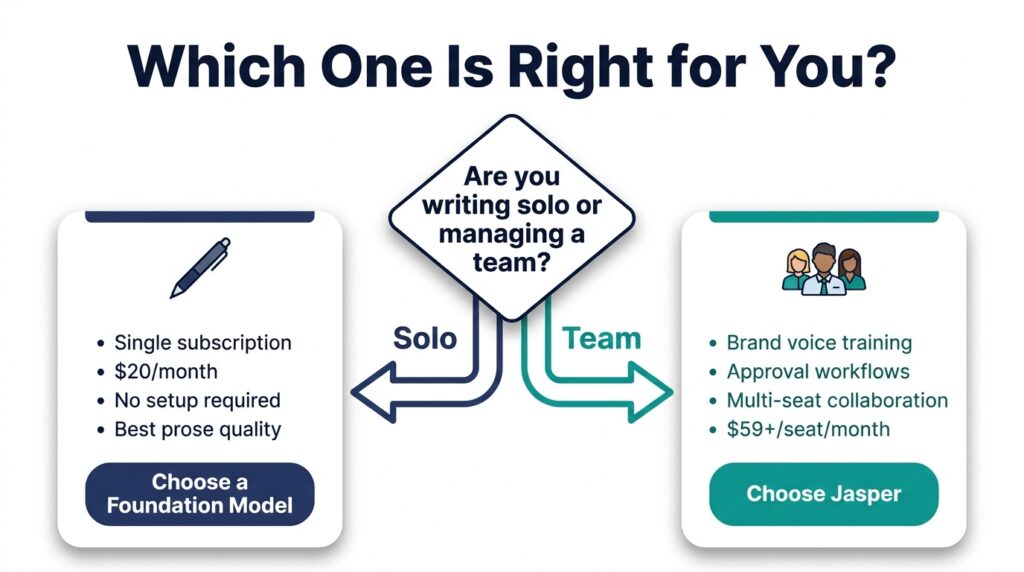
Where it falls short: The underlying writing quality is not meaningfully better than Claude or ChatGPT at the model level. At $59/seat/month versus $20 for a foundation model subscription, you are paying approximately a 3x premium for the workflow layer. That layer has genuine value for teams. For solo creators, it is almost certainly the wrong tool.
Right for: Marketing departments, agencies managing multiple brands, and content teams that need structured workflows, approvals, and enforced brand consistency. Solo writers should use a foundation model instead.
5. Writesonic — From $16/month
Ratings: Long-form quality: Good | SEO tooling: Best in test | Editing required: High | Pre-edit AI detection: 71% flagged
An AI writing and SEO platform that has pivoted heavily toward what it calls “Generative Engine Optimization” (GEO) — optimising content for visibility in both traditional search results and AI-generated answer surfaces. Writesonic integrates keyword research, SEO scoring, and article generation in one workflow.
Current pricing (verified June 2026):
- Free: 25 credits/month
- Lite: $16/month (limited article output)
- Standard: $39/month
- Professional: $75/month
- Enterprise: custom
Sources: TechSifted, 2026; StackScored, 2026. Note: Writesonic restructures its pricing tiers frequently. Always verify at writesonic.com/pricing before subscribing.
Test result — SEO article from keyword to draft
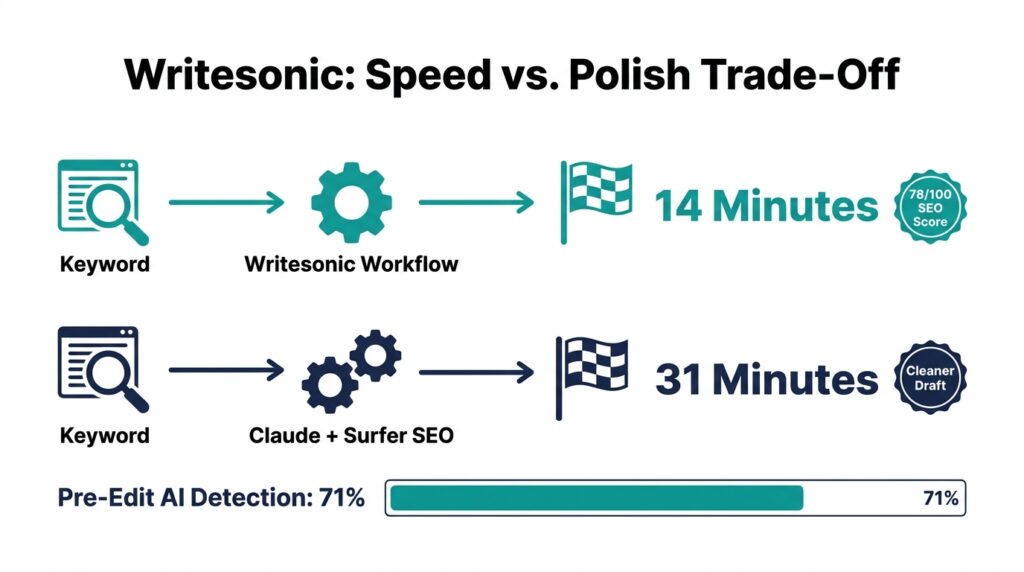
Starting from the keyword “best noise-cancelling headphones under $200,” I timed the full workflow on Writesonic versus the same task on Claude paired with a separate SEO tool (Surfer SEO). Writesonic produced a scored, structured draft in 14 minutes. The Claude and Surfer workflow took 31 minutes but produced a noticeably cleaner draft requiring less editing. The Writesonic draft scored 78/100 on its own SEO metric but contained three factual inaccuracies requiring correction and read more mechanically throughout.
Where it stands out: For teams whose primary goal is ranking content in search, Writesonic’s integrated tools reduce friction that other platforms require you to solve with third-party software. The article flow goes from keyword to structured, SEO-scored draft without leaving the platform.
Where it falls short: Writing quality varies, particularly on specialist topics. The 71% pre-edit AI detection rate — highest among the specialist platforms tested — means editing investment is mandatory before publication. Better understood as an SEO-optimised drafting tool than a polished writing assistant.
Right for: SEO agencies, affiliate site owners, and niche content publishers where search ranking is the primary metric and editorial teams can handle a higher editing load.
6. Copy.ai — $29/month (Chat) or $1,000/month (Growth)
Ratings: Long-form quality: Moderate | GTM automation at Growth tier: Excellent | Value for individuals: Poor
Copy.ai has repositioned itself as a go-to-market (GTM) automation platform rather than a writing tool. The focus is on sales and marketing workflow automation — generating outbound sequences, ad copy, landing page variants, and campaign assets at scale.
Current pricing (verified June 2026):
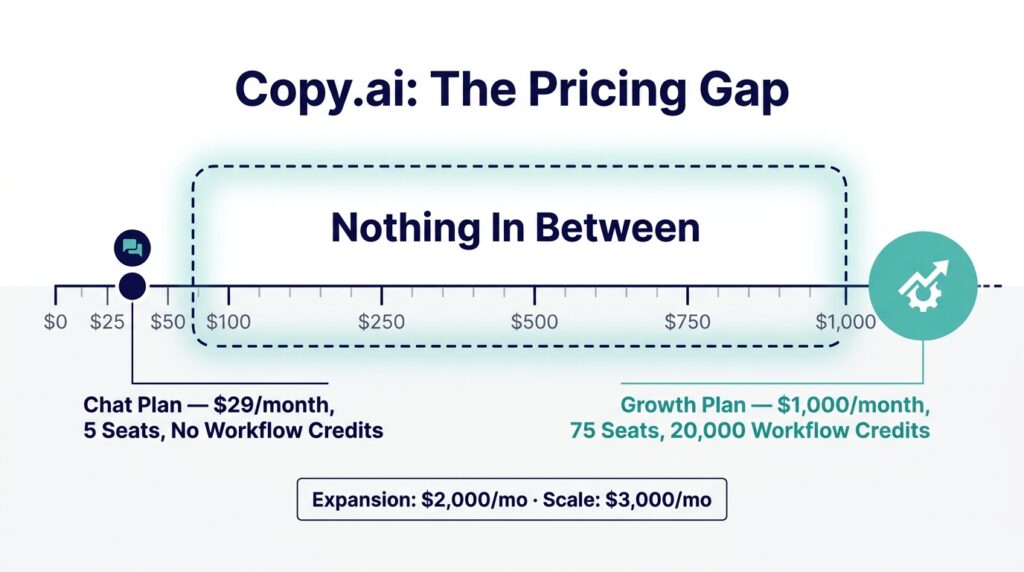
- Chat plan: $29/month ($24/month annual) — 5 seats, no workflow credits
- Growth plan: $1,000/month (annual only) — 75 seats, 20,000 workflow credits/month
- Expansion plan: $2,000/month — 150 seats, 45,000 workflow credits/month
- Scale plan: $3,000/month — 200 seats, 75,000 workflow credits/month
- Enterprise: custom
Source: Prospeo, 2026. Verify at copy.ai/pricing.
Critical note on the pricing gap: Copy.ai’s pricing has a significant gap that catches buyers off guard. The Chat plan at $29/month is essentially a chat interface with marketing templates — comparable in capability to using ChatGPT Plus with a well-crafted marketing prompt pack, at a higher price. The Growth plan, where the actual workflow automation platform begins, starts at $1,000/month billed annually. There is nothing meaningful in between. Many third-party directories still list old pricing tiers ($49/month, $249/month) that no longer exist [Prospeo, 2026].
Where it stands out: At the Growth tier, Copy.ai’s multi-step workflow automation is genuinely powerful for sales teams running high-volume outbound campaigns. The ability to build automated pipelines — pulling in data, generating personalised copy, routing for approval, and publishing — is difficult to replicate without custom development.
Where it falls short: Long-form article writing is not a strength. The Chat plan does not meaningfully differentiate from ChatGPT Plus at a lower price. The pricing gap means the tool either underserves or overcharges the majority of users.
Right for: Enterprise sales and marketing teams running high-volume GTM automation at the Growth tier and above. Individual writers and small marketing teams are better served by Claude or Jasper.
7. Rytr — Free to $29/month
Ratings: Long-form quality: Basic | Short-form speed: Excellent | Value on a budget: Best in test | Pre-edit AI detection: 79% flagged
A budget-focused AI writing assistant built for short-form content. Rytr handles social media captions, ad copy, email subject lines, product descriptions, and blog outlines quickly and cheaply. Note: Rytr’s pricing increased modestly between 2024 and 2026 — the Unlimited plan moved from $7.90 to $9/month, and the Premium plan from $24.90 to $29/month, a roughly 15–16% increase over two years [SeoRaf, 2026].
Current pricing (verified June 2026):
- Free: 10,000 characters/month
- Unlimited: $9/month (or $7.50/month billed annually) — unlimited generation, 1 language
- Premium: $29/month (or $24.16/month annually) — unlimited generation, 35+ languages, custom use cases, 100 plagiarism checks
Sources: Eddamoun, 2026; HyperWrite, 2026. Verify at rytr.me/#pricing.
Test result — 50 social captions in volume
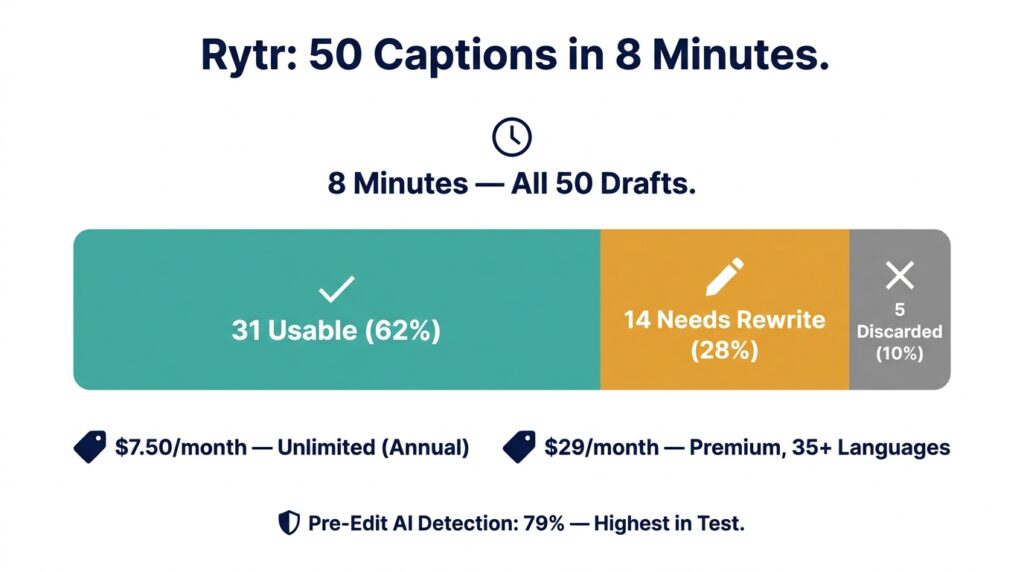
I used Rytr to generate 50 social media captions for an e-commerce fashion brand across Instagram, X, and LinkedIn, timing the process and measuring the usability rate. Rytr produced all 50 drafts in under 8 minutes. Of those, 31 (62%) were usable with light editing; 14 (28%) needed heavier rewrites; 5 (10%) were discarded. At $7.50/month billed annually for unlimited generation, the cost-per-usable-caption is effectively unmatched by any other tool in this test. The same task on Claude Pro took 22 minutes and produced higher-quality individual captions, but at a much slower pace for volume work.
Where it stands out: Price. The Unlimited plan at $7.50/month (annual) provides unlimited character generation — more output for less money than anything else tested. For businesses or freelancers needing a high volume of short-form drafts with editors to review them, Rytr’s ratio is genuinely hard to beat.
Where it falls short: Not built for long-form content, and it shows — output becomes repetitive and generic past a few hundred words [Eddamoun, 2026]. The 79% pre-edit AI detection rate (highest in this test) means every piece needs editing before publication. No direct integrations with WordPress, HubSpot, or Zapier require manual copy-paste between Rytr and your publishing tool.
Right for: Freelancers and small businesses with tight budgets who need high volumes of short-form copy drafts and have editing capacity to refine the output.
The Honest Decision Framework
Individual writers, bloggers, and freelancers: Claude Pro or ChatGPT Plus at $20/month. Both produce better prose than the specialist platforms at a fraction of the price of Jasper. Choose Claude if prose quality and tone-matching are the priority; ChatGPT Plus if you also need research integration, image generation, or workflow flexibility.
Marketing teams that need brand consistency: Jasper at $59/seat/month (annual) is the most structured solution tested. The brand voice and approval workflow features have real value for teams managing multiple writers or clients. Run the 7-day trial with your actual team before committing — the tool requires setup time before delivering consistent results.
SEO content production: Writesonic’s integrated keyword and scoring tools reduce friction for high-volume SEO work, with plans from $16/month. Budget for editing time — the 71% pre-edit AI detection rate requires review before publishing, and factual accuracy on specialist topics needs verification.
Sales and GTM automation at enterprise scale: Copy.ai at the Growth tier ($1,000/month, annual) is purpose-built for this. Ignore the Chat plan at $29/month — it does not meaningfully differ from ChatGPT Plus at a higher price.
Short-form copy on a strict budget: Rytr at $7.50/month (annual) handles social captions, ad copy, and email drafts at a cost nothing else in this test comes close to. Factor in editing time when calculating true cost per piece.
Research-heavy writing in Google Workspace: Google AI Pro at $19.99/month. The live search integration and Docs and Gmail embedding genuinely save time for teams already in the Google ecosystem, and the plan bundles 5TB of Google One storage as added value.
A Note on AI Detection and Real Cost
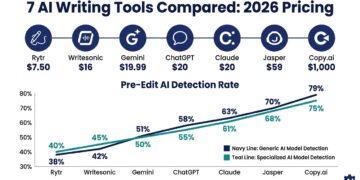
Across all seven tools, pre-edit AI detection rates ranged from 38% (Claude) to 79% (Rytr), measured using Originality.ai. These figures do not mean the content is bad — they mean editing time varies significantly by tool, and that variance affects real cost.
A tool that costs $7.50/month but requires 45 minutes of editing per article may cost more in effective hourly terms than a $20/month tool that needs 15 minutes. When evaluating any AI writing tool, calculate: subscription cost + editing time per piece + fact-checking time + the cost of any additional tools required (e.g. Surfer SEO at $89+/month if you need deep SEO scoring alongside a foundation model).
On search ranking: Google’s published guidance is that content quality, not production method, determines ranking. Well-edited AI-assisted content performs in search. Unedited output with factual errors, repetitive structure, or high detection flags does not. The 52% of marketers now running AI content through humanization tools before publishing suggests the industry has already absorbed this lesson [SupWriter, 2026].
Sources
Industry reports, pricing analyses, product reviews, and market research referenced throughout this comparison.
Frequently Asked Questions
Common questions about AI writing tools, pricing, content quality, AI detection, SEO, and choosing the right platform in 2026.