





The Real Problem With Modern Content Operations
Most content teams are not slow because their writers are slow. They are slow because their process is broken.
Research happens in one browser tab. Writing happens in another. SEO review gets added on at the end, usually by a different person. Then the piece sits in a review queue for three days before anyone touches it again. By the time it publishes, two weeks have passed and the topic may already be stale.
This fragmented workflow is the actual bottleneck — not a lack of talent or ideas.
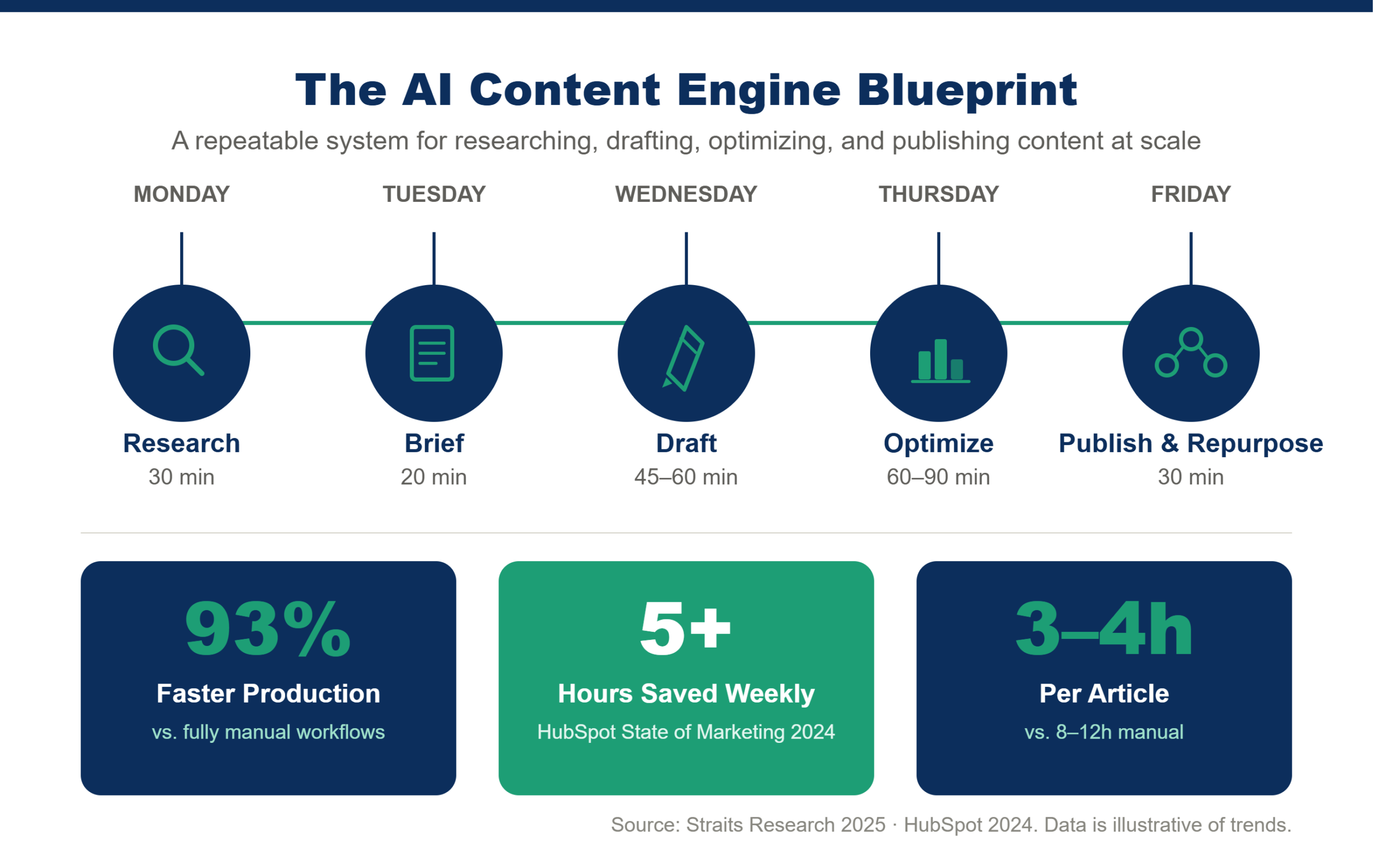
AI does not fix a broken process by itself. But when you use AI to redesign the process from the ground up, the results are measurable. According to Straits Research’s 2025 analysis, AI-assisted content creation can be up to 93% faster than fully manual workflows when comparing end-to-end production cycles, and marketers using AI complete 12.2% more tasks at a 25.1% higher rate. HubSpot’s 2024 State of Marketing report found that marketers using generative AI save more than five hours per week on content tasks alone.
That is what an AI Content Engine is built to capture.
What an AI Content Engine Actually Is
An AI Content Engine is not a writing tool. It is a repeatable production system that connects research, planning, drafting, editing, optimization, publishing, and distribution into a single workflow — with AI handling the high-volume, low-judgment tasks at each stage.
The distinction matters. Organizations that use AI only as a drafting tool still face all the same bottlenecks everywhere else. Organizations that build a full system report the biggest gains.
According to Grand View Research’s 2025 market report, the global generative AI content creation market was valued at $14.8 billion in 2024 and is projected to reach $80 billion by 2030, growing at a compound annual growth rate of 32.5%. HubSpot’s 2024 State of Marketing survey found that 71% of organizations were already using generative AI for content creation by 2025. That adoption is not happening because AI writes perfect prose — it is happening because the operational advantages of a well-built system compound over time.
The Five Layers of a High-Functioning AI Content System
Layer 1: Research and Topic Discovery
Every strong piece of content starts with a clear understanding of what the audience actually wants to know. AI accelerates this substantially — but the quality of your research inputs still determines the quality of everything that follows.
What AI handles well at this stage
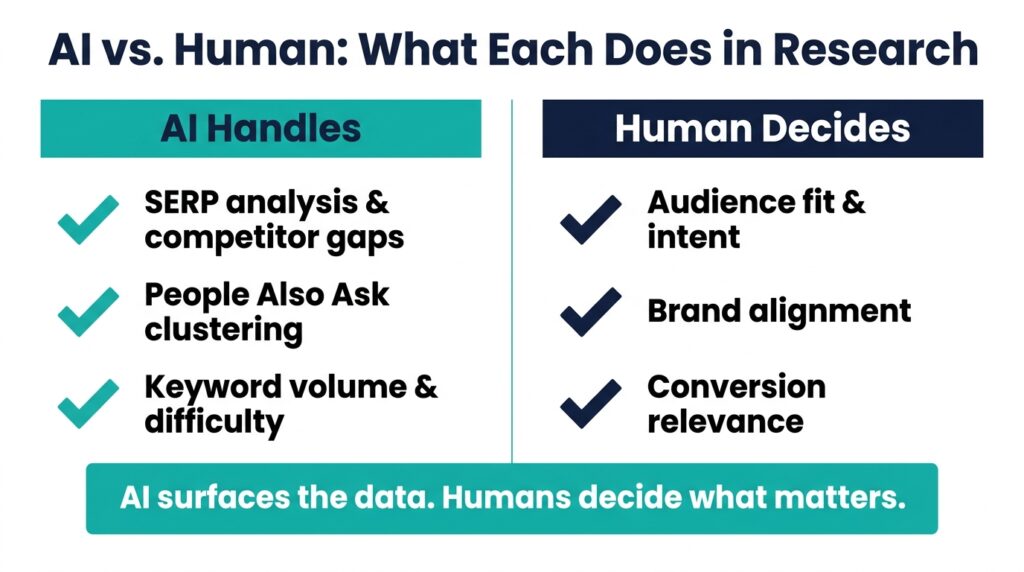
Tools like Frase and MarketMuse can analyze the top-ranking pages for any given keyword and surface the subtopics, questions, and entities those pages cover. Frase’s SERP brief builder pulls structure from competing pages automatically and organizes common “People Also Ask” questions so writers can see exactly what gaps exist before writing a single word. MarketMuse goes further by scoring your existing content library for topical authority gaps — telling you not just what to write, but what you are missing relative to your competitors.
Semrush and Ahrefs remain the standard for keyword volume and competitive gap analysis. Neither has been replaced by generative AI; they are still the most reliable sources for search volume data, keyword difficulty, and backlink intelligence.
What still requires human judgment
AI can surface trending topics, but it cannot tell you whether a topic aligns with your business goals or audience trust. A writer or strategist still needs to evaluate whether a high-volume keyword is actually worth targeting given your domain authority, your conversion funnel, and your editorial standards.
Earlier this year, while running topic discovery for a B2B SaaS client in the project management space, the AI surfaced “AI prompt engineering for marketers” as a high-opportunity gap. The keyword data was accurate — search volume was strong and competition was moderate. But the client’s audience was VP-level buyers who wanted strategic frameworks, not hands-on tutorials. Without that human filter, the team would have produced content that ranked but converted nothing.
Layer 2: Content Planning and Brief Creation
A content brief is the most underrated document in any content operation. A well-built brief takes 20 minutes to create and saves two or three revision cycles later. A missing brief is responsible for most of the “this isn’t what I asked for” conversations between editors and writers.
AI makes brief creation fast and consistent.
A practical workflow: paste your target keyword into Frase or Surfer SEO, generate a SERP-based outline, and review the suggested headings and subtopics against your own knowledge of the audience. Add the search intent (informational, transactional, navigational), target word count, required internal links, and any brand-specific guidelines. The brief is ready in under 30 minutes.
The output is a document that any writer — human or AI — can execute against without constant back-and-forth.
Layer 3: Draft Generation
This is where most teams start with AI, and where the most common mistakes happen.
The teams that get the best results from AI-generated drafts are not the ones prompting AI to “write a blog post about X.” They are the ones feeding AI a fully built brief with a defined structure, a specified audience, a tone reference, and explicit instructions about what the article should not include.
The difference in output quality is substantial.
One B2B SaaS content team I worked with used Jasper with detailed brand voice profiles and section-by-section instructions drawn from a structured brief. Their editors reported spending meaningfully less time on revisions compared to drafts produced from generic prompts — not because the AI had improved, but because the instructions had. The gains came from brief quality, not tool quality. That distinction matters when evaluating which part of your system to invest in.
The hybrid model is the standard
According to HubSpot’s 2024 State of Marketing report, 86% of marketers who use AI still spend time editing AI-generated content. Only 12% of marketers believe AI can manage a complete content strategy independently. The most effective teams treat AI drafts as a detailed first pass — valuable for structure, coverage, and speed — and add original analysis, real examples, and brand voice in the editing stage.
Tools most commonly used for draft generation in 2026
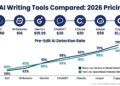
- Jasper — Best for teams needing consistent brand voice across multiple content types. Supports over 50 templates, integrates with Google Docs, and allows brand voice training. Pricing starts at $49/month for individuals. Outputs require significant human editing for depth and accuracy.
- ChatGPT (GPT-4o) — Flexible and fast for writers who prefer direct prompt control. No native SEO integration, but pairs well alongside Surfer or Frase.
- Writesonic — A more affordable option starting at $16/month. Solid for teams that need volume without a large budget. Output quality is generally a step below Jasper for nuanced copy.
- Copy.ai — Strong for short-form content and workflow automation. Particularly effective for email sequences and social captions.
A note on prompt engineering: the single highest-leverage skill for any writer working with AI tools is learning to write detailed, structured prompts. Specify the audience, the desired length per section, the tone, what not to say, and the format of the output. A well-constructed prompt consistently outperforms a generic one by a wider margin than most writers expect.
Layer 4: SEO Optimization
Generating a draft and optimizing a draft are two different tasks. Many teams conflate them and end up with content that reads well but ranks poorly — or ranks well but reads like it was assembled by someone counting keywords.
The most effective approach keeps creation and optimization as separate passes.
Surfer SEO remains the clearest tool for on-page optimization. Its Content Editor scores your draft in real time based on NLP term usage, word count, heading structure, and content depth compared to top-ranking competitors.
One important limitation worth understanding: Surfer’s scoring system is correlation-based. Pages that rank tend to use certain terms, so the tool recommends including them. A perfect Surfer score does not guarantee ranking — it is a quality floor, not a ranking guarantee. Google’s algorithm weighs hundreds of factors including backlinks, page experience, and topical authority that no content scoring tool can fully account for.
In testing this across several client sites over the past two years, a 68 content score on a well-argued, genuinely useful article has consistently outperformed a 97 score on a piece that feels like keyword soup. Optimize for coverage and readability, not for the number itself.
For practical use: run a completed draft through Surfer’s Content Editor before publishing. Address major gaps in term coverage and heading structure. Stop optimizing once readability starts to suffer.
Clearscope is a strong alternative for teams that prioritize readability alongside SEO — its interface is cleaner and its suggestions tend to feel less mechanical. It is worth testing alongside Surfer on a few articles before committing to one tool for your team’s workflow.
Layer 5: Publishing, Distribution, and Repurposing
The most underused part of any content operation is repurposing.
A well-researched 2,000-word article contains enough raw material for a LinkedIn post, a Twitter/X thread, a short-form email newsletter, a video script, and an infographic brief. Most teams publish the article and stop there. This is a significant missed opportunity.
AI handles repurposing well. The prompt structure is straightforward: “Here is a published article. Extract the three most counterintuitive insights and rewrite them as a LinkedIn post in a direct, first-person voice. No bullet points. Under 250 words.”
The output requires light editing, not a full rewrite.
Distribution tools worth knowing
- Buffer and Hootsuite — Standard for scheduling social content. Both have added AI caption generation features in recent versions.
- Beehiiv and ConvertKit — Preferred newsletter platforms for independent publishers. Neither is AI-native, but both integrate cleanly with AI-generated email drafts.
- Zapier — For automating the movement of content between tools. A practical example: when a WordPress post publishes, automatically draft a summary in Notion and create a social posting task in Asana — without any manual handoffs.
A Real Workflow, Step by Step
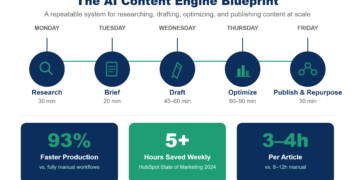
Here is how a functioning AI Content Engine runs in practice for a mid-sized B2B content team:
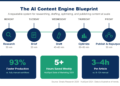
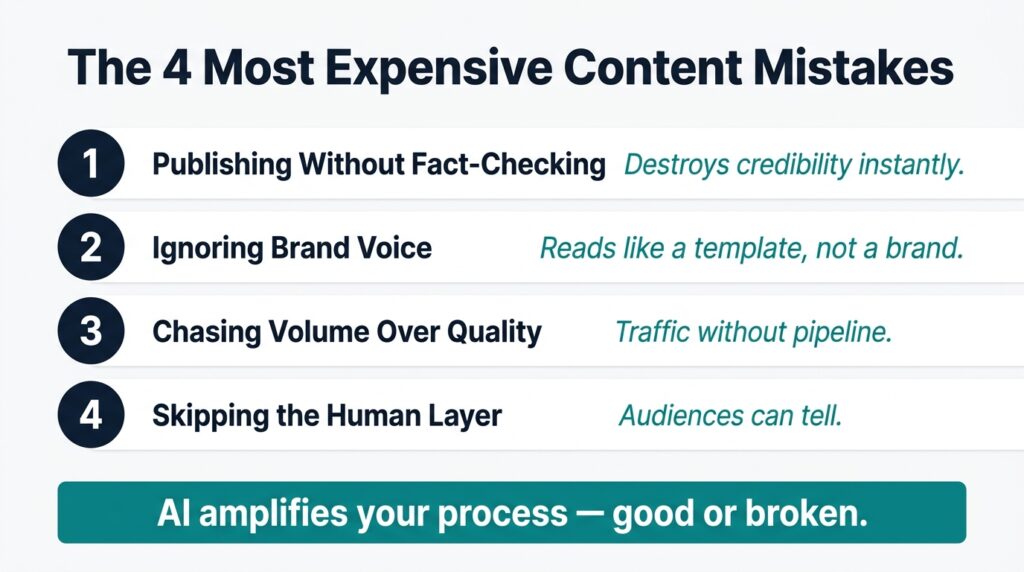
Monday — Topic Approval (30 minutes) A strategist reviews the content calendar, pulls keyword opportunities from Semrush, and confirms which topics to brief for the week. AI is used to generate a quick competitive summary for each topic.
Tuesday — Brief Creation (20 minutes per piece) A writer or AI specialist builds briefs using Frase or Surfer. Each brief includes: target keyword, secondary keywords, audience intent, suggested headings, required word count, internal link targets, and tone notes.
Wednesday — Draft Generation (45–60 minutes per piece) A writer uses Jasper or ChatGPT with the brief as the prompt foundation. They write the introduction and conclusion themselves, and use AI to draft the body sections. All factual claims are flagged for verification in the next stage.
Thursday — Human Editing and Fact-Checking (60–90 minutes per piece) An editor adds original examples, verifies every statistic against its primary source, corrects any factual errors, adjusts brand voice, and runs the draft through Surfer for SEO scoring.
Friday — Publish and Repurpose (30 minutes) Content uploads to WordPress or the relevant CMS. A prompt-generated LinkedIn post, email teaser, and X thread are scheduled in Buffer.
Total estimated time per article: 3–4 hours. A comparable piece produced through a traditional full-manual workflow typically takes 8–12 hours based on editorial team benchmarks across multiple client engagements. The productivity gain is real, but it comes from the system — not from any single tool.
What Goes Wrong: The Four Most Expensive Mistakes
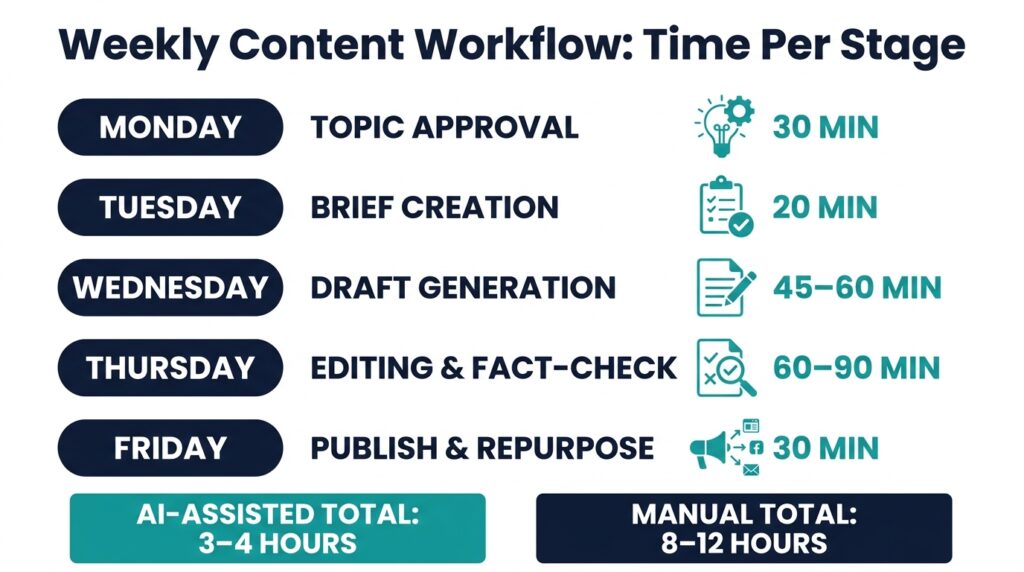
Publishing without fact-checking. AI models can confidently produce incorrect statistics, misattribute quotes, and invent citations that sound plausible. Every statistic in an AI-generated draft should be verified against its original source before publishing. This is non-negotiable — and the reason every data point in this article is linked to its primary research source.
Ignoring brand voice. AI-generated content defaults to a generic professional register that works for no brand in particular. Without explicit voice guidelines — tone, vocabulary preferences, sentence length, what the brand would never say — content will sound like it came from a template. Create a brand voice document and include it in every AI prompt or brief.
Chasing volume over quality. The assumption that “more content equals more traffic” is not supported by how Google’s helpful content system evaluates pages. A single genuinely useful, well-researched article on a competitive topic will outperform ten thin articles on the same subject. AI makes it easy to publish at high volume; the discipline is knowing when not to.
Skipping the human layer entirely. HubSpot’s 2024 data shows that only 12% of marketers believe AI can fully manage content strategy on its own — and they are right to be skeptical. The gap between what AI produces and what audiences trust still requires human expertise, judgment, and original perspective to close.
Measuring Whether Your Content Engine Is Working
A content operation has to be measured at multiple levels, or you risk optimizing the wrong thing.
Production efficiency metrics — articles per week, average hours per article, cost per published piece. These tell you whether the system is functioning.
SEO performance metrics — organic sessions, keyword rankings, click-through rate from search. These tell you whether the content is reaching the right people.
Engagement metrics — average time on page, scroll depth, social shares, email open rates on repurposed content. These tell you whether people find the content valuable once they arrive.
Business outcome metrics — leads generated, demo requests, trial signups, revenue attribution. These are the only metrics that ultimately justify the investment.
A common mistake is optimizing production speed at the expense of business outcomes. Publishing twice as many articles per month is meaningless if none of them generate pipeline. Build your measurement framework with the outcome metrics as the north star, and let the production metrics inform how efficiently you are getting there.
What Is Coming Next
The current generation of AI content tools is effective but still requires meaningful human orchestration. The next generation is moving toward greater autonomy.
Several platforms are already in early deployment for automated content updating — identifying articles where rankings have declined, diagnosing likely causes, and proposing or drafting updates without human initiation. Personalization at the content level, where the same URL serves different article variants based on user segment or acquisition source, is in active development at larger media and e-commerce operations.
For most content teams, the practical priority in 2026 is not chasing the frontier — it is building a clean, well-documented system with the tools that already exist. The organizations that will have the biggest advantage in two years are not the ones that adopt the newest tools first. They are the ones that have spent this period building reliable processes, training editors to work well alongside AI, and developing content libraries with genuine depth and authority.
The technology will keep improving. The compounding advantage belongs to the teams who build durable systems now.
Sources
Research reports, industry surveys, and market analysis referenced throughout this article.
Frequently Asked Questions
Common questions about AI content engines, AI-assisted publishing, SEO workflows, and content operations in 2026.